
Blue Banner Image for Content

Pension Reform and Private Markets: What it Means for Talent in Financial Services

Posted August 12, 2025

If you’re working in the Financial Services industry, then it will have been hard to ignore the latest changes set to take shape across the UK pensions market.

And the changes are big. The entire UK pension landscape is now on the cusp of a transformation that will have far-reaching implications, not just for savers, but for the entire financial services sector.

In this blog we’ll lay out exactly what the proposed changes are and what they might mean for talent and hiring across the financial services sector.

Let’s go.

What is the UK Pension Reform?

Well, the 2025 Pension Investment Review and the Mansion House Accord have recently set ambitious targets designed to turbocharge investment in the UK economy and reshape how retirement savings are managed. This is set to have implications across many businesses and how they run and manage their employee pension pots.

What impact will the Pension Reform have?

Under the current system, by 2030 all multi-employer defined contribution schemes and Local Government Pension Scheme pools are expected to hit £25 billion in assets under management, which will create what’s known in the industry as “megafunds.”

However, the new Mansion House Accord (which has been signed by 17 of the UK’s largest pension providers), will commit these providers to invest 10% of default fund assets into private markets, with 5% earmarked for UK-based opportunities.

Collectively, this could unlock up to £50 billion for infrastructure, private equity, venture capital, and other “productive finance” in the UK by the end of the decade.

This change represents a fundamental shift in how UK pensions are managed, how capital flows through the UK economy and what skills the sector will need.

What changes might the UK see after the Pension Reform comes into effect?

Today, only a handful of UK pension providers manage default funds above the £25bn threshold. But by 2030, that number is set to double. We’ll see smaller schemes merge or wind down, and the defined contribution market will consolidate into a small number of heavyweight “megafunds” instead.

At the same time, pension portfolios are set to pivot.

Currently, only about 2% of defined contribution pension assets are invested in private markets and that figure is expected to quintuple to 10% by 2030 which is a dramatic shift into asset classes such as unlisted companies, infrastructure projects, and renewable energy.

Will the Reform cause demand for specific job roles and skills?

So, what exactly does this Pension Reform mean for talent and hiring?

Well, according to our data we’re predicting an increased demand for the following skills:

Change and Transformation

The drive to merge dozens of smaller schemes into megafunds will create a demand for specialist skills to manage this transformation. Providers will need Project Managers, Business Analysts, Actuaries, and Integration specialists who can navigate bulk transfers, align systems, and manage cultural integration across merged schemes.

Investments

Megafunds will need to manage increasingly complex portfolios. This will drive a surge in demand for Investment Managers to source, evaluate, and structure deals in private equity, venture capital, infrastructure, and private debt and Project Finance Specialists to analyse and fund major UK projects in transport, energy, and housing.

Governance, Risk & Compliance

Higher allocations to different asset classes will bring increased scrutiny. Pension funds will bolster their risk management and compliance functions, seeking professionals who can manage stress testing, oversee charge-cap compliance, and ensure investments stay aligned with fiduciary duties.

What challenges might there be for hiring?

While an increasing demand for certain skill sets might be a good thing for the market, these changes and surges do present additional challenges.

Mainly that these skills are already in high demand. Private markets analysts, actuaries, infrastructure finance specialists, and risk experts are among the most sought-after profiles in the financial services workforce today.

For HR and Talent teams, this comes at a time when they are already juggling business-as-usual hiring, driving internal mobility programmes, and spearheading reskilling initiatives to futureproof their organisations. Layer on top the ongoing need to assess how AI will reshape roles and processes, and it’s clear that talent strategies will need to be sharper, more creative, and more competitive than ever to secure the expertise required for this pensions-driven shift.

How we can help

At Sanderson, our team are well versed in navigating the often-murky waters of the UK financial services hiring market. Not only do we have access to some of the best talent pools in the UK to get you the skills you need and fast, but we understand the complexities of future-proofing your hiring strategies while trying to manage day-to-day talent management tasks.

If you’re looking for support, or would just like to chat to us about what the Pension Reform might mean for you and your business, then reach out to us today and let’s chat about how we can help.

Blue Banner Image for Content

Mergers and Acquisitions in Financial Services: Hiring Insights You Need to Know

Posted July 29, 2025

Is momentum finally starting to build across the Change & Transformation market?

You might have seen that we recently launched our latest Change & Transformation Insights Report where we dipped into data suggesting that 2025 is showing signs of increased activity as more and more businesses are re-engaging with their transformation agendas thanks to budget approvals and team mobilisations.

In this blog we’ll explore the noticeable uptick in M&A activity within financial services and lay out the key insights you need to know on what this means for hiring in the Change & Transformation sector.

What does the M&A market currently look like?

Looking at our data as well as sources such as KPMG’s 2025 M&A Outlook, 2024 was somewhat of a turnaround year for M&A markets. By the back end of 2024 the value of domestic M&A reached a whopping £8.6 billion and thanks to this we are seeing a huge surge in M&A activity this year.

For example, in the financial services space we’ve seen the likes of Nationwide acquire Virgin Money, Coventry Building Society acquire Co-Op Bank, Barclays acquire Tesco Bank to name just a few. And it’s looking like this growth in activity is set to continue through the rest of 2025.

What is driving this high rate of M&A activity in the financial services sector?

It largely comes down to economies of scale. Smaller financial services firms are finding it increasingly difficult to keep up with regulatory requirements, the increased need for digitalisation and wider competitive pressures.

M&A offers them the opportunity to become part of something larger and more resilient. We’re seeing strong evidence of the industry gravitating towards consolidation and a “safety in numbers” mentality as they prioritise stability over disruption.

What does all this M&A activity mean from a hiring perspective?

Well, when an M&A is initiated at a business, we usually then tend to see a significant spike in contract hiring at the beginning of this process.

Permanent roles are still important, but in our experience, we often see companies feel hesitant in committing to permanent positions while they navigate the start of such a fluid situation. Instead, hiring activity is initially focused on contractual positions and often there’s a preference for candidates who have a familiarity with “Part VII” of the Financial Services and Markets Act i.e. the legal framework for transferring assets and liabilities from one company to another. Businesses find themselves needing contractors who can fill positions like Business Analysts, Project Managers and HR professionals who can help guide them through the integration process.

With an initial focus on internal systems, as this stabilises resourcing then starts to look to permanent hires or consultancy services as they put their energy into filling customer facing roles.

What skills and attributes do employers look for when hiring for large transformation programmes like M&A?

In our experience, the skills employers look to hire for during a transformation project vary depending on the specific phase of the transformation project they’re at.

For example, if a business comes to us with a hard deadline such as getting their acquired company onto their payroll system, then delivery-focused candidates are a must.

But on the other hand, if their focus is on people and organisational change then soft skills like empathy, communication and stakeholder management become crucial.

What is the Top 5 industries for M&A talent right now?

According to data, we’re seeing a lot of activity in sectors like:

  • Asset Management
  • Banking
  • Payments
  • Fintech
  • Insurance

How can you attract M&A talent to your organisation?

Looking at our data sources, while things like excellent compensation and benefits packages are still important, candidates are also favouring added benefits like flexible work arrangements, the opportunity to get stuck into impactful work and even things like collaboration in the company culture.

Are you looking to find out more?

If this blog has whetted your appetite to find out even more about the Change & Transformation market, then why not take a look at the full Report? Chockers full of industry-leading data (including salary benchmarking stats), it’s like having our expertise in your back pocket to set you up for hiring success.

And if you have any questions or would like to dig a little deeper into anything discussed in this blog, feel free to reach out to me on [email protected]

Download your copy of the full Change & Transformation Insights Report here

Blue Banner Image for Content

What’s Happening with Financial Services Recruitment in London?

Posted March 20, 2025

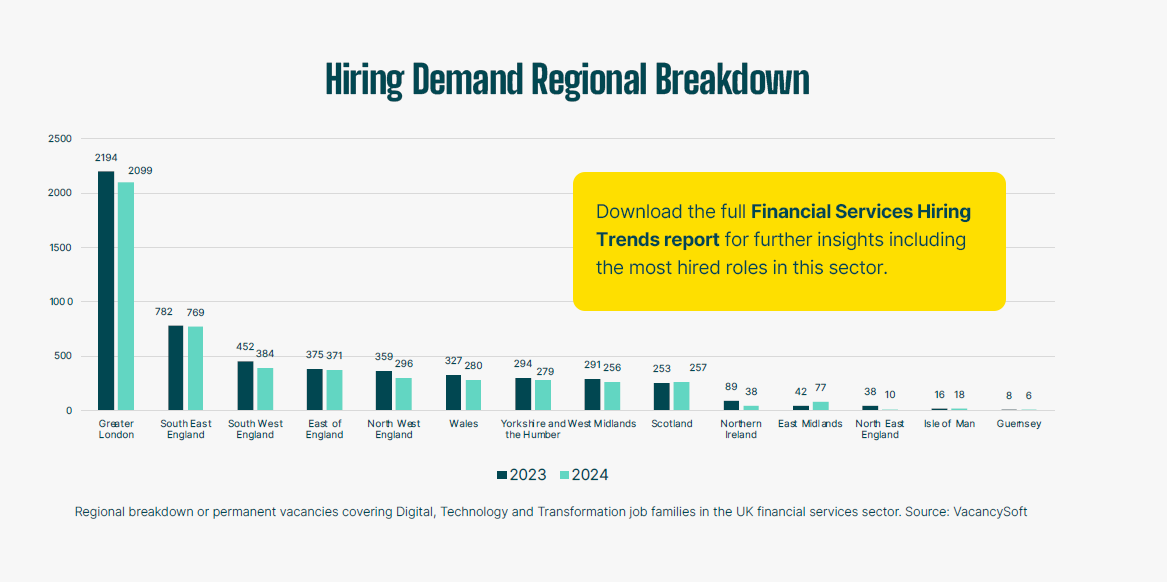
We recently launched our much-anticipated Financial Services Hiring Trends Report which focuses on Digital, Technology, Change and Transformation hiring in the Financial Services sector. The Report delves into how hiring in 2024 compared to the previous year, how hiring demand was split across the UK and what the most in demand roles were across the financial services sector.

But what did the data show us about trends in London?

Permanent finance vacancies

According to data from VacancySoft and reviewed by our expert recruiters, the hiring demand for permanent vacancies covering digital, technology, change and transformation in the UK financial services sector has remained highest across Greater London and the South-East of England.

In 2023 there were 2194 vacancies in Greater London, and then an equally high 2099 in 2024. Looking at the South-East region, there were 782 vacancies in 2023 followed by 769 in 2024.


These vacancies are miles ahead in numbers compared to the rest of the UK. For example, the North-West only saw 359 and 296 vacancies in 2023 and 2024 respectively, and the West Midlands only had 291 and 256. This confirms that London and surrounding areas are a real hub of talent and that there continues to be a real demand for talent in the financial services sector.

Hiring trends in London

London is one of Sanderson’s largest markets in the financial services sector, with our expertise spanning across General Insurance, London Market Insurance, Life & Pensions, Investment Management, Banking and Building Societies.

When you look at the hiring trends in this region across the world of Finance, it’s clear that London continues to lead the way in UK in digital, technology, change and transformation hiring in the financial services sector. Hiring demand in London has also been more resilient to the impact of external factors like political uncertainty and economic challenges. This is demonstrated by vacancies across the UK declining by 8.5%, whereas they only declined by 4.4% in London – a clear indicator that the market in London remained strong. Also, the trend we saw back in 2023 of a shift away from London towards regional hubs such as Manchester has slowed.

What will the future look like?

It’s clear that London is at the centre of hiring demand in the financial services sector. But what else should we be aware of in this region and sector?

One thing we’ll be keeping a close eye on is the return to the office, particularly in Financial Services firms in London. We’re already seeing more consistent patterns of 3 days per week in the office and a some of our clients returning to as many as 4 days in London across all roles regardless of whether they’re in digital, technology or transformation.

This is a marked swing back towards the majority of the week being spent in the office, and while hybrid working is here to stay, it does mean less choice for job seekers requiring more remote roles.

I’d therefore expect that we start to see less movement in this sector based purely on what hybrid working schedules companies are offering and instead see trends returning to a more level playing field with other factors in the job offering holding more weight as we progress through 2025/2026.

Next steps

Are you ready to find out more?

As we leave Q1 behind, now is the time to start thinking about enhancing operational efficiencies, addressing your skills gaps and supporting the reskilling of your existing workforce with the right blend of permanent employees, contractors and consultancies.

Arm yourself with data produced by Sanderson’s market-leading experts by downloading a copy of our Financial Services Hiring Trends Annual Report by filling out the short form below.

Have any further questions or considering how your London based business can get ahead of these hiring trends? Don’t hesitate to get in touch with Joss Collins on [email protected]

Download the full Financial Services Hiring Trends Annual Report here

insights

Annual Report: Financial Services Hiring Trends

Posted March 12, 2025

We’re pleased to present Sanderson’s brand-new hiring trends report focusing on Digital, Technology, Change and Transformation hiring in the Financial Services sector in 2024.

This much anticipated report arms you with industry-leading data on how hiring in 2024 compared to the previous year, how hiring demand was split across the UK and what the most in demand roles were across the financial services sector.

It will have escaped no one’s attention that hiring trends in 2024 reflected a year of uncertainty. Thanks to economic challenges and political instability, the year saw many companies having to adopt a cautious approach to recruitment as business confidence was knocked.

Many companies in the financial services sector will currently be reassessing their hiring strategies in preparation for the changes in National Insurance contributions for employers set to take effect in April 2025, alongside ensuring they’re business strategies are aligned with the rapid digital transformation AI is bringing to the sector.

Now is the time to think about enhancing operational efficiencies, addressing your skills gaps and supporting the reskilling of your existing workforce with the right blend of permanent employees, contractors and consultancies.

This report, produced by Sanderson’s market-leading experts, reflects on how the business context has been impacted in the past and provides our predictions for the future of hiring in the financial services sector.

Download your copy by filling out the short form below and get all the data you need in your back pocket.

Have any further questions on the trends discussed in this report? Don’t hesitate to contact William Boney at [email protected]

Blue Banner Image for Content

Meet Leah Jones and our Operations Delivery Team

Posted October 30, 2024

With over a decade of experience in the recruitment industry, Leah leads Sanderson’s Operations Delivery team, who specialise in Contact Centre hires for multiple large FCA regulated clients across the UK.  

The Operations Delivery team are experts in placing high quality candidates in a variety of positions that fall under both the Customer Service and Sales umbrellas, delivering both in volume and at pace, they thrive on absorbing each client’s culture and acting as an extension of their brand.  

Leah and her team understand that every customer is different and as such they will focus on designing and delivering a bespoke solution that successfully meets our client challenges and objectives. 

Here, Leah tells her story of working with a large client in the Financial Services sector who were experiencing an unprecedented demand in sales and customer service hiring, with 525 roles confirmed in Q1.  

What was the challenge?

The client needed a Project RPO (Recruitment Process Outsourcing) partner who could mobilise quickly, adopt their process and technology, understand their culture and values, and deliver a package of 120 hires across some of their key locations. We were selected to do the work due to a combination of the existing relationship with the client and our knowledge of volume hiring capability. 

What did we achieve together?

  • Rapid Mobilisation – The talent acquisition team and our team quickly organised a series of workshops to define requirements and agree solutions. Legal and Procurement teams worked swiftly and collaboratively to draft, agree, and sign an agreement within one week, maintaining the momentum of the project
  • Orientation and Communication – The whole Sanderson team visited the client, spending time with the talent acquisition team, and meeting recent hires to quickly immerse themselves in the culture, values, and requirements. Both parties ran workshops with senior business stakeholders to explain the purpose of the project, the amended process and the quality control measures in place to ensure that hiring managers received the same quality of service that they enjoyed from the in-house team.
  • Execution – We quickly adopted client processes, including brand, technology and diversity monitoring and worked as an extension of the talent acquisition team, providing daily progress reports, and attending team meetings to ensure the smooth running of the project. In addition to delivering the hiring project, we:
    • Invited the client into our offices to show them how we structure delivery and share our approach to talent pipelining and attracting passive candidates.
    • Provided advice, training, mentoring and guidance on the optimum model for talent acquisition at the client.
    • Provided ad hoc, support, guidance, and market intelligence to support our clients talent acquisition transformation programme.  

It is this transparency and partnership that has delivered the most long-lasting results.  

The client has adopted many of our recommendations as part of the restructure and has a renewed confidence that they have the structure, knowledge, and process to continue to deliver an outstanding service to the business in the post pandemic world.  

The immediate results have been exceptional

  • Reduced stakeholder involvement (time) by 60%
  • Cost per hire reduced by 28%
  • Early indications of an increase in employee retention rates

What did the client say?

The project not only fulfilled an immediate need but gave us a platform to learn and develop. We wouldn’t be where we are today without the contribution of Sanderson.” – Recruitment Manager 

Leah followed on to highlight that:  

“Fostering a strong partnership with our client was vital to the impressive outcomes on this Project RPO, both my teams hard work and our client’s willingness to embrace us as an extension of their team, was key to achieving our shared goals and driving success together. The true testament is the ongoing relationship we still have following the success and the end of the project! If you have any resourcing issues that you would like to discuss, please do not hesitate to reach out to me for an initial conversation on how we could support with a bespoke solution to suit your needs”. 

How Sanderson’s Project RPO Service Can Help You

Sanderson’s Project RPO solutions are designed for businesses who need access to talent acquisition expertise but are not looking to outsource everything. Our solution can be delivered as a “one off” engagement, working as an extension of your in-house talent acquisition team to source, screen and deliver the right candidates or teams as and when you need them. As your resourcing partner, Sanderson will act as a helping hand, saving time for you to navigate your people strategies and day to day BAU.

If you’re interested to find out more, head over to our Project RPO page here.

Get in touch

We’re always open to a chat to discuss how we may be able to help you achieve similar results, so please do reach out