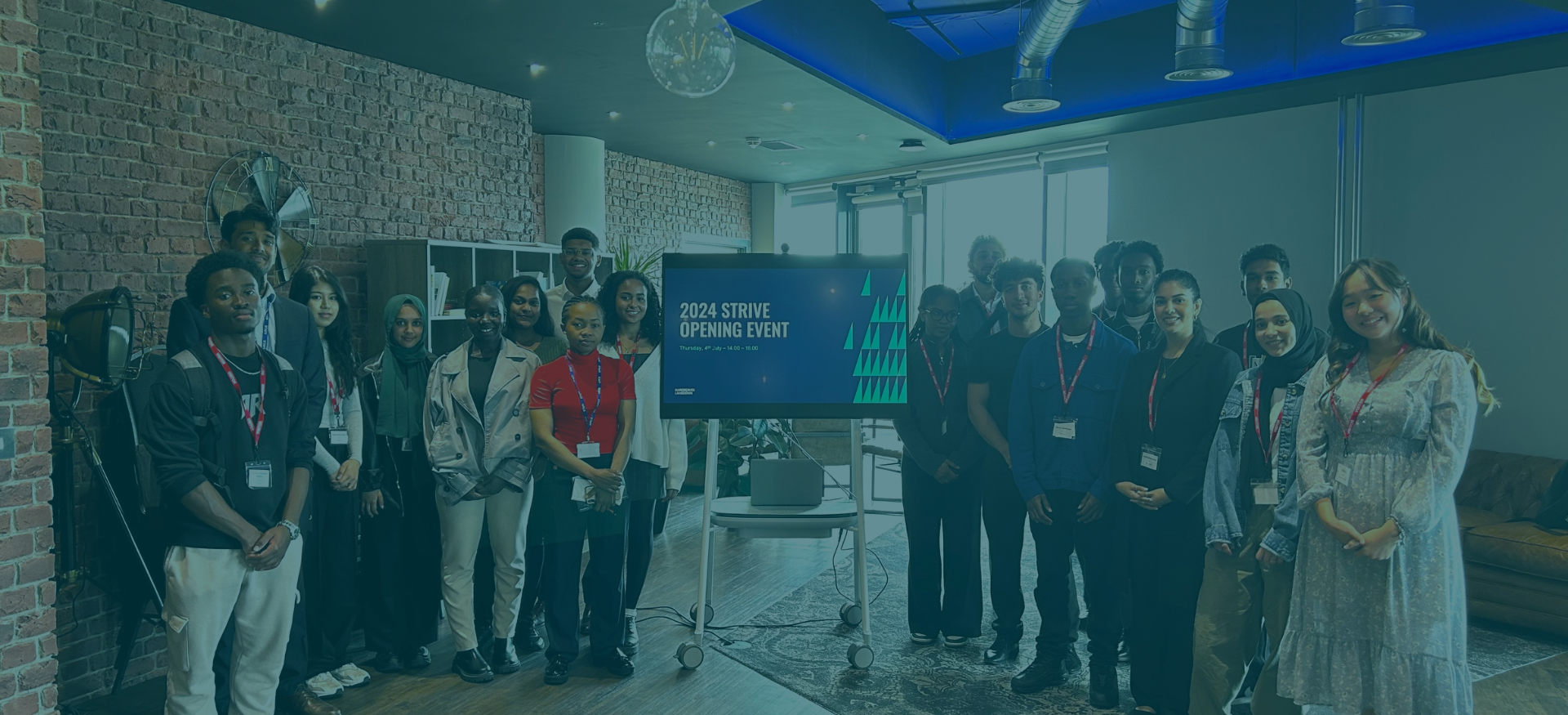
strive-banner

Strive 2026: Celebrating another year of talent, growth and opportunity

Posted October 6, 2026

On Thursday 24th September at Ashton Gate Stadium, we were pleased to welcome more than fifty interns, employers and partners to celebrate the end of the 2026 Strive Internship Programme.

For those who don’t know, the Strive Internship Programme matches undergraduate students from global majority backgrounds for 6-8 week paid internships over the summer holidays in organisations throughout the South West of the UK.

Sanderson have been proud to manage the programme since 2025, when we took over from the founders Hargreaves Lansdown, and throughout the programme we’ve been pleased to run in-person events and weekly Life Skills Sessions, all with the aim of supporting the interns to build their confidence, pick up crucial transferable skills and cement the beginnings of their professional networks.

In this blog we catch up with our Responsible Business Lead Ellie Barnfield on her reflections of the 2026 Strive Programme, including shining a light on some of this year’s brilliant interns and hearing from employers who took part.

Strive is continuing to grow year-on-year

From 29 placements last year to 46 this year, it’s clear that appetite for Strive is growing. This couldn’t be more timely given how challenging the graduate jobs market is right now.

In 2026, the average graduate role receives 140 applications. For context, in 2002/3, the average was 30 applications per graduate role. Simultaneously, graduate vacancies are at their lowest levels since 2012.

While this problem is felt across society, it’s particularly acute in underrepresented groups. Students from global majority backgrounds have persistently lower levels of employment post-university than their White counterparts, and introducing additional factors of disadvantage (such as neurodivergence or care experience) further exacerbates the gap.

For that reason, we’re delighted with the increase in placements.

But it isn’t just the interns themselves who benefit. It’s been brilliant to see growing recognition that early careers initiatives like Strive can create value for employers too.

More than work experience

We’ve heard from our employer partners this year that inviting interns into their organisations brings fresh thinking, new energy to teams and helps build future talent pipelines.

Other benefits that employers have felt include creating stronger links with local communities, supporting diversity and inclusion goals and even giving junior employees the opportunity to mentor and develop their own management skills.

Here are some testimonials from employers in the 2026 Strive Programme:

Dan Foster, Head of Talent Acquisition and Impact at Unite Students, said:

“As a Bristol-founded business, we’re passionate about investing in the communities and talent that contribute to our local economy. With increasing discussion around the decline in early careers opportunities, we saw Strive as a chance to create meaningful work experience and development opportunities for young people who may not otherwise have access to them. The opportunity to welcome nine interns into our business for seven weeks was something we were incredibly excited to support, and it aligned perfectly with both our talent and social impact ambitions.”

And Sophie Holmes, Legal Operations Team Leader at ARAG, said:

“The programme has had a very positive impact within the organisation. It allowed us to connect with enthusiastic and capable candidates from diverse backgrounds, bringing fresh perspectives and ideas. It also provided development opportunities for members of my team to get involved in mentoring and supporting others. In addition, it reinforced our commitment to attracting future talent and promoting social mobility within the legal profession.”

Strive 2026 in numbers

  • 46 internships delivered
  • 15 employer partners
  • 633 applications
  • Students from 17 universities
  • 100% intern satisfaction
  • 3 permanent roles offered

Recognising the stand-outs of the summer

This year for the first time, we were very excited to introduce the ‘Strive Awards’. Nominated by the interns and line managers who took part in Strive, the Awards recognised interns who shone and employers that created meaningful learning opportunities, invested time in mentoring and went above and beyond to help interns succeed. This year our winners were…

Intern Awards

Outstanding Internship Contribution: Nafisa Ahmed, Bishop Fleming (nominated by Anna Sherwood)

“Nafisa has made an exceptional contribution throughout her placement and has consistently exceeded expectations…What particularly stood out was Nafisa’s ability to recognise when she needed support while also being confident enough to take ownership of more complex areas of the audit. She was proactive in asking thoughtful questions, acted on feedback, and applied what she had learned to future work”. – Anna Sherwood, Bishop Fleming (nomination for Outstanding Internship Contribution)

Honourable Mention: Puren Sokmek, UWE (nominated by Emmanuel Adukwu)

Rising Star: Ashley Jacob, CFMS (nominated by Jory Griffin)

Honourable Mention: Josephine Cole, Avon & Somerset Police (nominated by Esther Wride)

Problem-Solver: Nicol Joseph, Unite Students (nominated by Dan Foster)

Future Leader: Hassan Noor, Sanderson (nominated by Deima Krisiuleviciute)

Top Teammate: Neve Hughes, Bristol City Council (nominated by Ash Kent)

Honourable Mention: Sharif Naim, Sanderson (nominated by Deima Krisiuleviciute)

Employer Awards

Outstanding Internship Host: Hargreaves Lansdown

Best Learning & Development Experience: Bishop Fleming

Outstanding Mentor or Supervisor: Ash Kent, Bristol City Council

“[Ash] has facilitated such a fun and inspiring during my time with the Bristol Council, whilst being kind at supportive throughout which really allowed me to feel a part of the team. Ash has also done an incredible job organising my weekly schedule, ensuring that each day is never the same, by introducing me to a variety of different teams and departments within the council. Overall, this experience has been so insightful for me, making the working world much less intimidating and has provided me the skills I need to purse a career in the environmental sector.” – Neve Hughes (nomination for Outstanding Mentor or Supervisor)

Looking ahead

The stories shared throughout the event reminded us that Strive creates benefits far beyond a summer placement. Students gain confidence, skills and professional networks. Employers gain fresh perspectives, engaged teams and the opportunity to make a meaningful contribution to the future workforce.

As another successful year comes to a close, the message from both interns and employers was clear: this is an experience worth being part of.

As we start looking towards next summer, we’re determined to continue growing the programme.

Our aim is to reach 60 placements in 2027. So if you think you could offer one of them, please don’t hesitate to contact [email protected].

Blue Banner Image for Content

Five Ways to Build Diverse Technical Leadership Teams

Posted September 22, 2026

Technology leadership is evolving. Today’s tech leaders are no longer just responsible for systems and infrastructure. They’re getting involved with everything from engineering delivery and business strategy to leading transformation programmes and influencing organisational growth.

But despite all this evolution, diversity within tech leadership teams is still a challenge for many organisations.

It’s a well-documented fact that businesses with diverse leadership teams are also associated with improved innovation, employee experience and decision-making outcomes. In fact, research has found that organisations with greater diversity in leadership are 39% more likely to outperform their competitors financially.

So more and more we’re finding ourselves having conversations with clients about how to improve the diversity of their own technology leadership teams as they look to recruit senior technology and engineering leaders.

In this blog we’ve caught up with Recruitment Consultant Herbie Fontaine to explore his quick top tips for businesses starting out on their own journey to build stronger, more diverse technology leadership teams, hot off the press from his own conversations with clients.

Let’s get going!

  1. Rethink what great technical leadership looks like

The most successful organisations focus less on finding someone who looks like previous leaders and more on identifying individuals who can deliver impact, build teams and drive change.

A common mistake is unintentionally limiting available talent pools by only looking for leaders who have the same career background as previous leaders in the business, but in reality exceptional technology leadership comes in many forms, no matter a candidate’s career history.

We’ve seen organisations successfully broaden their technical leadership talent pool by considering candidates from the public sector, consulting and even council roles rather than focusing solely on those who’ve followed traditional technology leadership career paths.

  1. Stop waiting for diversity at leadership level

A common frustration we hear from hiring managers is there “aren’t enough diverse candidates available in the market”. But if you’re only focusing on diversity when recruiting for leadership positions, then you’re probably addressing the issue too late.

The organisations making the most progress in the diversity of their technology leadership teams are those that are creating pathways to leadership rather than relying solely on external hires. They’re building diverse leadership through long-term investment in things like mentoring programmes, sponsorship opportunities and development courses.

  1. Build diverse hiring processes, not just diverse shortlists

A diverse shortlist is only one part of the equation. The hiring process itself should play a significant role in attracting and securing diverse leadership talent.

In our experience, senior technology candidates evaluate organisations throughout every interaction during the hiring process. They’re looking for things like how visible inclusion is across the current leadership team, not just reading a sentence about it on a careers page.

  1. Hire for diversity of thought

Representation is an essential part of diversity, but diversity of thought is just as important in leadership teams. Technology leaders face complex decisions around AI, cyber security, cloud strategy and digital transformation, and if you have a team all from the same background, they’re going to be approaching those challenges in the same way.

Hiring managers should be open to leaders from different career paths to encourage healthy debate within teams and better decision making.

  1. Create a culture where diverse leaders thrive

Attracting diverse talent is only part of the equation, retaining that talent is just as important.

The strongest organisations create environments where leaders feel comfortable sharing different perspectives, challenging ideas and being their full selves at work. Without an inclusive culture, even the best hiring strategy will struggle to deliver lasting results.

Building diverse technical leadership teams for the future

Diverse technology leadership teams don’t happen by accident. They’re built through conscious hiring decisions, inclusive cultures and a willingness to look beyond traditional leadership profiles. Organisations that invest in diversity today will be better placed to innovate, adapt and grow in an increasingly complex technology landscape.

At Sanderson, we work closely with organisations on technology leadership recruitment, helping them identify and attract technology leaders who can deliver impact while strengthening the diversity of their leadership teams. So, whether you’re hiring a CTO, Engineering Director or Head of Technology, our specialist consultants can combine deep market insight with inclusive recruitment practices to help you access the broadest possible talent pool.

If you’re looking to build a diverse technology leadership team of your own, we’d love to start the conversation.

Blue Banner Image for Content

National Inclusion Week 2026: 7 Practical Ways to Build Inclusion That Lasts

Posted September 14, 2026

National Inclusion Week 2026 starts today, giving employers across the UK a valuable opportunity to celebrate inclusion, start important conversations and reflect on how it shows up in everyday working life.

But inclusion is not something we can build in one week. The real opportunity is to turn those conversations into practical action that continues well beyond September.

This year’s theme, ‘Build Trust. Navigate Change’, feels particularly relevant. Organisations and their people are adapting to new technology, changing skills needs, economic pressures and different expectations of work. That can be exciting, but it can also leave people feeling uncertain about what change means for them.

At Sanderson, we believe inclusion should never sit separately from those conversations. It is part of how organisations build trust, make better decisions and help people feel informed, respected and able to contribute.

So, how can employers use this week to create meaningful change that lasts?

What is National Inclusion Week?

National Inclusion Week is an annual campaign that encourages organisations to celebrate inclusion and take action to create workplaces where everyone feels respected, valued and able to contribute. In 2026, the focus is on how employers can build trust and support their people through change.

The week can be a great catalyst, but inclusion is not created by one event, workshop or social media post. It is shaped by everyday decisions about recruitment, communication, accessibility and development, as well as whose voices are heard when change is happening.

So, where do you start? Here are seven practical ideas that can make a difference during National Inclusion Week and beyond.

  1. Start by listening, not assuming

It can be tempting to begin with a full calendar of events and activities. Before you do, start by asking colleagues what inclusion currently feels like in your organisation and what would make the biggest difference to them.

People will not all experience the same workplace in the same way. Working location, disability, neurodivergence, ethnicity, faith, caring responsibilities, seniority and employment type can all affect whether someone feels heard and able to participate.

Give people more than one way to have their say. A short anonymous survey, small listening groups and individual conversations can help you hear from colleagues who may not feel comfortable speaking during a large session.

Useful questions could include:

  • When do you feel most able to contribute at work?
  • Are there any processes or behaviours that create unnecessary barriers?
  • Do you feel comfortable asking for support or reasonable adjustments?
  • What is one change that would help you feel more included?

Most importantly, be clear about what will happen next. Asking for feedback is only the first step. Trust grows when people can see that you have listened, considered what they said and taken action.

  1. Review recruitment through an inclusion lens

For many people, the recruitment process is their first proper experience of an organisation’s culture. If inclusion matters to your business, candidates should be able to see and feel that long before their first day.

National Inclusion Week is a good time to choose one live vacancy and review the whole candidate journey. Look at the job advert, application route, selection criteria, interview process, communications and onboarding experience.

Consider whether:

  • The advert uses clear, inclusive and accessible language.
  • Essential requirements are genuinely essential to the role.
  • Candidates know that reasonable adjustments are available and how to request them.
  • Interview questions are structured and assessed consistently.
  • Hiring decisions focus on relevant skills and evidence rather than familiarity or “culture fit”.
  • Candidates receive clear information about what to expect at each stage.

Inclusive hiring is a core part of how we work at Sanderson and how we support our clients and candidates. In 2026, we were really pleased to achieve a ‘Confident’ Talent Spaces Inclusive Hiring Certification following an independent assessment of our recruitment policies, advertising, learning materials and delivery across Permanent, Contract and RPO recruitment.

The assessment recognised our skills-first mindset, approach to candidate care, inclusive attraction practices and thoughtful conversations around accessibility. We are proud of that progress, but we also see it as a stepping stone and a clear framework for continuing to improve.

Importantly, this was not just an internal review. Sanderson was assessed across six stages of the recruitment lifecycle and benchmarked against comparable recruitment organisations. The assessment found that our consistent use of reasonable-adjustment statements was a sector-leading strength, alongside our transparent candidate communication, preparation and approach to accessibility.

You can learn more about inclusive hiring at Sanderson.

  1. Help managers lead inclusively through change

How change is communicated and managed can have a huge effect on trust. When information is unclear, decisions feel closed or the same voices are repeatedly missing, people can quickly feel that change is being done to them rather than shaped with them.

Encourage managers to ask a few simple questions before introducing a change:

  • Who could experience this differently?
  • Whose perspective have we not yet heard?
  • Could the timing, technology, location or communication format create a barrier?
  • What flexibility or support might people need?
  • How will we check for unintended consequences?

Inclusive leadership does not mean having every answer. It means being open about what you know, honest about what is still being decided and willing to adapt when someone points out a barrier you may not have considered.

This is especially important when changing working practices, introducing new technology or restructuring teams. Bringing equality and accessibility into the conversation from the start is much easier than trying to fix avoidable barriers afterwards.

  1. Create access to meaningful early-career opportunities

Inclusion is not just about making current processes fairer. It is also about looking honestly at who has historically had access to opportunities and finding practical ways to open more doors.

The award-winning Strive Internship Programme is a great example. Strive places students from global majority backgrounds into paid summer work placements with local employers. Since launching in 2020, the programme has provided 134 internships across more than 35 organisations in the South West, helping students build valuable experience, confidence, professional networks and employability skills.

Sanderson took over the programme in 2025, bringing together employers, universities and the public sector with a shared goal of improving employment outcomes for global majority communities.

For employers, taking part is about much more than offering a placement. It is a chance to connect with new talent pools, welcome fresh ideas into the business and build a more inclusive early-careers pipeline. Participating organisations offer a six-to-eight-week summer placement, pay the Real Living Wage and support interns to grow their skills and networks.

Employers interested in supporting a future Strive intern can register their interest with the programme.

If a formal internship programme is not possible right now, what smaller step could you take? You might offer paid work experience, rethink where entry-level opportunities are advertised, build relationships with a wider range of education providers or remove unnecessary experience requirements from junior roles.

  1. Make inclusion part of everyday working practices

A busy programme during National Inclusion Week can create some brilliant conversations. Ultimately, though, it is people’s everyday experiences that determine whether they really feel included and that they belong.

Choose one or two practical habits that teams can continue throughout the year. For example:

  • Share meeting materials in advance and use accessible formats.
  • Build in different ways to contribute, including verbally, in writing and after the meeting.
  • Rotate visible or career-enhancing opportunities rather than relying on the same volunteers.
  • Avoid scheduling important activity around major religious or cultural dates where possible.
  • Make hybrid meetings work equally well for remote and office-based colleagues.
  • Explain decisions and close the feedback loop when colleagues have contributed.
  • Make conversations about reasonable adjustments routine and supportive.

None of these ideas needs to be complicated. Small changes can be really powerful when they become consistent habits. Instead of asking teams to make a broad commitment to “be more inclusive”, agree a few specific behaviours that people can recognise, practise and review together.

At Sanderson, we are also building an Inclusive Hiring ambassador programme to help turn learning into everyday practice. Our champions will receive in-depth training and meet regularly to share best practice, identify improvements and build knowledge across the business. It is a practical example of how organisations can keep inclusion moving long after National Inclusion Week has finished.

Training matters too. Sanderson’s inclusion-related e-learning was recognised through the assessment as exceeding sector norms, supported by senior leadership endorsement and inclusion within our induction programme. Providing learning regularly, rather than only when an awareness date comes around, helps give people the confidence to put inclusive behaviours into practice.

  1. Turn awareness dates into action

Awareness days and weeks can help us start important conversations, understand different experiences and share useful learning. The challenge is making sure all that positive energy leads somewhere.

That is exactly why we created the Sanderson 2026 Diversity, Equity & Inclusion Calendar. Rather than simply listing awareness dates, this free resource includes practical activities, suggested formats and clear impact areas to help employers support inclusion, wellbeing and belonging throughout the year.

There is no need to recognise every date or launch a major campaign every month. Choose the moments that mean the most to your people, organisation and communities. For each one, ask:

  • What do we want people to understand or experience differently?
  • What practical activity will support that outcome?
  • Who will take responsibility for the next step?
  • How will we know whether it made a difference?

You do not have to do everything at once. One thoughtful activity that leads to a real change can have far more impact than a packed calendar with no clear follow-up.

  1. Measure change, not just participation

It is always encouraging to see lots of people attend an event or engage with a campaign. But participation figures alone cannot tell you whether your workplace has become more inclusive.

Alongside event participation, look at evidence such as:

  • Whether colleagues feel safe speaking up and sharing different views.
  • Uptake and experience of reasonable adjustments.
  • Candidate feedback and recruitment outcomes at each stage.
  • Access to development, promotion and high-profile work.
  • Employee engagement, progression and retention across different groups.
  • Whether actions agreed through listening exercises are completed on time.

Before National Inclusion Week ends, choose at least one action, give it a named owner and set a date to check progress. Then tell colleagues what is happening. Closing that feedback loop shows that the week was designed to create change, not just conversation.

National Inclusion Week checklist for employers

Not sure where to begin? Here is a simple checklist to help turn National Inclusion Week into meaningful action:

  • Ask colleagues what would help them feel more included at work.
  • Choose one workplace process to review through an inclusion and accessibility lens.
  • Check that job adverts and recruitment communications are digitally accessible.
  • Remind candidates and employees how they can request reasonable adjustments.
  • Give managers practical guidance for communicating and leading change inclusively.
  • Identify one way to widen access to work experience or early-career opportunities.
  • Agree a specific action, owner, timescale and measure of success.
  • Report back to colleagues and review progress after the week has ended.

Inclusion is built through what happens next

At Sanderson, our Responsible Business approach is focused on the positive impact we can make for our environment, communities and employees. Our work on inclusive hiring, our leadership of the Strive Internship Programme and our practical DE&I Calendar all come back to the same belief: meaningful inclusion is built through consistent action.

As our Responsible Business Lead, Ellie Barnfield, puts it:

“Recruitment is a business that, perhaps more than any other, is about people.”

National Inclusion Week gives every employer a chance to pause, listen and refocus. No organisation is going to solve everything in seven days, and that should not be the aim. Start with one honest conversation, one process that could work better and one action you are prepared to carry forward.

That is how trust is built. And it is how inclusion continues well beyond National Inclusion Week.

To explore more practical resources, view Sanderson’s free 2026 DE&I Calendar or contact our team to discuss how we can support a more inclusive approach to attracting, hiring and retaining talent.

Blue Banner Image for Content

Creating Inclusive Workplaces: What HR Leaders Are Learning

Posted March 13, 2026

We recently brought together senior HR leaders from a range of industries in Birmingham for a focused discussion on building inclusive workplaces. The conversation centred on three key themes: the role of AI in truly seeing the real candidate, how organisations can maintain a sense of belonging amid growing societal polarisation, and the impact of rapid change on inclusion.

The conversation opened with a critical question: Will AI reduce bias in recruitment or risk amplifying it? And how can employers ensure they’re still seeing the “real” candidate? The group explored a range of perspectives and practical approaches.

HR leaders using AI

When it comes to vetting talent, HR leaders are using AI in very different ways. Larger organisations with thousands of frontline staff are increasingly exploring AI tools like Phenom for the first stage of screening. It helps them deal with higher volumes of candidates quickly and consistently. But as soon as they reach the second stage, or for shared services roles where specific skills or cultural fit really matter, human interaction really needs to come into play.

That said, employers are also experimenting with gamification at this second stage, asking candidates to respond to problem-based scenarios and is an approach one of Sanderson’s larger RPO clients is using. Psychometric testing also continues to play a big role in complementing AI and building a more rounded view of the candidate.

Meanwhile, for organisations hiring fewer people each year, the cost of a bad hire is simply too high. They feel AI can help, but not replace the human conversations needed to understand culture, behaviours and nuance.

That doesn’t mean these teams avoid AI altogether. Tools like Copilot are now everyday helpers for creating the right email tone, shaping interview questions or supporting hiring managers during assessments. One approach taken is to use Copilot to personalise candidate experience by generating challenging, behaviour-based interview questions, designed to distinguish those high performing candidates. Another approach is to use Copilot to transcribe and analyse candidate responses, freeing the hiring manager up to actively listen and build rapport and helping to identify the most authentic and insightful answers.

Candidates using AI

On the other side of the recruitment process, more candidates are using AI to polish their CVs and personal statements. This has led to a huge uptick in applications, often up 500 per role, and yet conversion to the next stage can be low, as there is a clear gap between an AI enhanced application and how a candidate presents in person. This presents a key challenge on hiring manager’s time. Nuance, communication style and attitude certainly come through best in human conversation.

No one felt that candidates should be penalised for using AI. In fact, many viewed it as a positive, being able to leverage AI to save time and communicate clearly is a valuable skill, especially as more organisations integrate these tools into their everyday tasks.

A key takeaway for this topic?  “AI can make us the best version of ourselves”

Across the diverse group of HR leaders in the room, the message was consistent: AI can genuinely enhance recruitment, but only when it works alongside people, not instead of them. Whether you’re a hiring manager or a candidate, the combination of AI’s efficiency and human insight is what leads to the best outcomes.

Maintaining a sense of belonging amid growing societal polarisation

We then turned to the theme of belonging and asked: How can organisations maintain a sense of belonging amid growing societal polarisation?

This topic enabled HR Leaders to reflect on how the workplace can be a mirror to society and the challenges associated with aligning a multi-generational and increasing polarised workforce with common goals and values. Over the last few years, increasing societal polarisation has made it harder for HR teams to determine the right approach to DE&I.

To build deeper understanding across differences, one senior HR leader is using reverse mentoring, pairing apprentices with executive leaders to encourage mutual learning and broaden perspectives.

Another organisation is piloting internal “speed networking” sessions, enabling senior leaders to meet employees from across the business through short, focused conversations aimed at improving connection and understanding.

Inclusive culture through the lens of organisational transformation

Our final topic extended the themes of belonging and inclusive culture through the lens of organisational transformation.

The discussion naturally leant itself toward the challenges of maintaining inclusivity during mergers and acquisitions. Rapid or extensive change can risk undermining inclusion efforts, particularly when integration happens at pace.

When acquiring an organisation larger than your own, a key question emerged: do you retain your culture, adopt theirs, or establish a new shared culture? One HR leader emphasised the importance of grounding decisions in the three pillars of organisational design, organisational change and organisational development, while maintaining clarity on the purpose and intent of the acquisition.

In many cases, pre‑planning is shortened once a deal is completed, making it harder for affected employees to feel included. This highlights the need for deliberate, early planning and transparent communication to support an inclusive transition.

Conclusion

The future of inclusive workplaces depends on how confidently we blend human insight with technology. AI can sharpen decisions and widen perspectives, but real connection still comes from conversations.

At Sanderson, we were left with the feeling that inclusion isn’t a project, it’s a craft. It takes intention and a genuine commitment to creating workplaces where people feel seen and valued. As organisations navigate change, it’s these human centred choices that determine whether people simply work somewhere or truly belong.

Would you like to be part of the Inclusive Workplaces conversation?

We are planning more round tables across the regions, creating relaxed, open spaces for HR leaders to connect, share experiences and learn from one another.

If you’re looking for a supportive place to swap ideas with peers who are navigating similar challenges, and gain fresh perspectives along the way, just drop us an email. We’d be delighted to have you involved.

Blue Banner Image for Content

2026 Diversity, Equity & Inclusion Calendar: Turning Awareness into Action

Posted January 12, 2026

We’re excited to officially launch our 2026 Diversity, Equity & Inclusion (DE&I) Calendar – a free, practical resource designed to help organisations move beyond awareness and towards real, measurable culture change.

A DE&I calendar designed for real workplaces

Many Diversity, Equity & Inclusion Calendars focus on highlighting awareness days. And while these dates are important, organisations are often left asking:

“What should we actually do to make an impact?”

Our 2026 DE&I Calendar is designed to answer that question.

Rather than simply listing dates, this calendar provides practical, action-led activities that help organisations embed inclusion into everyday working life. It supports leaders, managers and teams to move away from tick-box approaches and towards meaningful, long-term inclusion.

Inside the 2026 calendar, you’ll find:

  • Key Diversity, Equity & Inclusion awareness dates for 2026.
  • Practical activities that support inclusion, wellbeing and belonging.
  • A strong focus on impact over performative action.
  • Clear impact areas outlining what each activity is designed to improve.
  • A suggested format to make implementation straightforward and scalable.

This structure helps organisations turn good intentions into consistent, achievable action.

Supporting meaningful inclusion and culture change

The activities included in the 2026 DE&I Calendar are designed to help organisations:

  • Strengthen inclusion and belonging across teams.
  • Support employee wellbeing in meaningful, human ways.
  • Build cultural awareness and confidence at all levels.
  • Drive long-term cultural improvement, not one-off moments.

You don’t need to do everything at once. In fact, we encourage organisations to start small – by one activity or one focus area – and build momentum over time. Consistent action creates sustainable change.

Who is the DE&I Calendar for?

The calendar is designed for organisations of all sizes and sectors, particularly those who want to:

  • Improve workplace culture.
  • Embed DE&I into everyday business practices.
  • Support inclusive leadership and people management.
  • Move beyond awareness into action.

Whether you’re continuing the journey from our 2025 calendar or discovering it for the first time, this resource is designed to support practical progress.

Get your free 2026 Diversity, Equity & Inclusion Calendar

Our 2026 DE&I Calendar is completely free and available as a digital resource. We hope this year’s calendar helps you take confident, meaningful steps towards building a more inclusive workplace in 2026 and beyond.

Download your copy in the short form below.

Strive Group Pic Web

Strive for Change: Join the Movement Empowering Young Talent in the South West

Posted November 3, 2025

Since its launch in 2020, the Strive Internship Programme has opened doors for over 130 young people from underrepresented backgrounds, connecting them with meaningful opportunities across 35+ organisations in the South West. Now under the leadership of Sanderson, Strive is more than just a summer internship — it’s a movement for equity, inclusion, and real-world impact.

Why Strive Matters

Strive isn’t just about work experience. It’s about belonging, mentorship, and representation. It’s about helping young people see their potential — and giving employers the chance to discover untapped talent that can transform their teams and culture.

This year, we’re celebrating the success of Strive 2025 and looking ahead to an even bigger 2026. And we want you to be part of it.

You’re Invited: Strive 2026 Launch Event

📍 Ashton Gate, Bristol
📅Wednesday 21st January 2026
🍸 Drinks, canapés, and inspiring conversations

Join us for an evening of connection and inspiration. Hear from past interns and employers, meet Bristol Bears special guest Gabriel Ibitoye and explore how your organisation can get involved.

Register your interest here

What You’ll Take Away

Our panel will explore powerful questions like:

  • What does opportunity really mean?
  • How does mentorship unlock potential?
  • Why does representation matter in the workplace?
  • What barriers still exist — and how can we break them down?

Expect some inspiring stories you can take back to your organisation.

Let’s Build a More Inclusive Future — Together

Strive is your chance to be part of something bigger; to invest in the next generation and to create a workplace where everyone feels they belong.

Join us at the 2026 launch!

Blue Banner Image for Content

Cultivating Harmony White Paper: Strategies for a Multi-Generational Workforce

Posted April 9, 2025

Sanderson Government & Defence is pleased to present this new White Paper produced in partnership with The HR World. The Paper provides a vital insight into the importance and potential of the multi-generational workforce and brings together the ideas and experiences of some of the leading HR practitioners in the UK.

The multi-generational workforce represents one of the most challenging aspects about the workplace today. With some organisations seeing up to five generations working side by side, it’s an issue which impacts on all areas of HR and the running of an age diverse team is an aspect of the workplace that requires a lot of careful consideration.

Challenges of a Multi-Generational Workforce

A multi-generational workforce can cause challenges such as:

  • Communication gaps and different generations preferring different methods of communicating.
  • Different generations having different expectations from the workplace both in terms of what they put in and what they get out.
  • Knowledge transferring and succession planning as older generations retire.

Opportunities of a Multi-Generational Workforce

However, with these challenges also come opportunities.

An age diverse workforce means a business can make the most of the talent that’s out there. It can bring in diverse viewpoints, strengths and ideas for the good of all parts of the organisation. It can not only use the skills of everyone in the organisation, but it can also confidently appeal to every generation in its customer base.

Strategies for working with a Multi-Generational Workforce

Offering a comprehensive insight into how the multigenerational workforce operates in today’s workplace, this White Paper provides you with practical steps for organisations to follow in order to get more from all their employees including:

  • Fostering Open Communication
  • Embracing Flexibility
  • Implementing Mentoring and Reverse Mentoring
  • Creating Inclusive Policies
  • Encouraging Continuous Learning

As the workforce and talent pool continues to diversify, HR needs to develop the right approach to welcome and maximise the benefit of its age diverse employees. With Generation Alpha waiting in the wings, the challenge of delivering for everyone in the workplace will only increase.

Make sure you’re prepared by finding out more in the full White Paper. Download your own copy by filling out the short form below and don’t hesitate to get in touch with Nick Walrond or Mollie Hatton if you have any further questions or would like to chat about this topic further.

Are you ready to maximise the benefits of your age diverse workforce? Find strategies for multi-generational success in this new White Paper.

Blue Banner Image for Content

The 100-Year Life: A New Perspective on Ageing

Posted January 9, 2025

The prospect of living to 100 is now increasingly realistic in today’s day and age.

This is a topic I’ve been exploring a lot as I believe it’s crucial for the UK government and defence sector to get to grips with this and adapt to this new reality if they’re to harness the full potential of a multigenerational workforce.

In my previous blog, I explored the concept of the 100-year life and how advancements in healthcare, lifestyle changes, and technology are enabling people to live longer, healthier lives. In this next instalment, I’m taking a deeper dive into this topic thanks to exciting new research published in Nature Ageing, which reveals that baby boomers are now ageing so slowly that 70 really is the new 60.

So let’s take look…

The Slow Ageing Phenomenon

Recent studies have shown that the biological markers of ageing are shifting, particularly for the baby boomer generation. This research indicates that individuals in their 70s today exhibit health and vitality levels comparable to those in their 60s a few decades ago

This shift can be attributed to several factors:

  1. Improved Healthcare: Advances in medical science have significantly enhanced the management of chronic diseases and preventive care.
  2. Healthier Lifestyles: Increased awareness of the importance of diet, exercise, and mental well-being has led to healthier lifestyle choices.
  3. Technological Innovations: Wearable technology and telemedicine have made it easier for individuals to monitor and manage their health proactively.


What This Means for Society

I believe the implications of this slow ageing phenomenon are profound.

As people live longer and healthier lives, we can expect to see changes in various aspects of society such as:

  • Workforce Dynamics: With people remaining healthier for longer, the traditional retirement age may shift, allowing for extended careers and new opportunities for lifelong learning and development.
  • Healthcare Systems: There will be a growing need for healthcare systems to adapt to the needs of an ageing population, focusing on preventive care and chronic disease management.
  • Social Structures: Communities and families will need to adjust to the reality of multi-generational living, with more active and engaged older adults.

Embracing the Future

As we continue to understand the science of ageing, it becomes clear that our perceptions of age and vitality are evolving. The idea that “70 is the new 60” is not just a catchy phrase but a reflection of the remarkable progress we have made in extending the healthy years of life.

And that means that we must look to the over 50’s as a viable and long-term career group that will be critical to the health of the UK employment market.

More thought needs to be given to attracting and mobilising this generation.

The journey towards a 100-year life is not just about adding years to life but adding life to years. By embracing healthier lifestyles, leveraging technological advancements, and adapting our societal structures, we can look forward to a future where ageing is not something to be feared but celebrated, and where our working lives will extend well into our 70’s for many of us.

What this means for the Government & Defence sector

Specifically, to the world that we service, I think real thought and time needs to be given to the following points:

  • How to harness multi-generational talent
  • Adapting workforce policies to make them fit the generations (hire to retire policies etc…)
  • Improved Health and Wellbeing policies to enable a positive extended working life
  • Learning and development initiatives that enable reskilling later in careers

With well documented Digital, Data, Cyber skills shortages across the Defence and Government sectors in the UK now is the time to harness the potential of the extended working life, I really believe it will be a critical skills channel of the future.


If you would like to discuss this topic further, please don’t hesitate to get in touch with me.

[email protected]

Blue Banner Image for Content

Embracing Longevity: Strategies for a 100-Year Life in the Workplace

Posted December 3, 2024

In today’s day and age, the prospect of living to 100 is becoming increasingly realistic.

This shift, explored in depth by Lynda Gratton and Andrew J. Scott in their seminal book “The 100-Year Life”, can actually have profound implications for how we approach our careers, education, and personal lives.

This is a topic I’ve been exploring in-depth (as you might have seen in my previous blog last month) and I believe that it’s crucial for organisations, particularly those in the UK government and defence sector, to properly understand and adapt to this new reality if they’re to harness the full potential of a multigenerational workforce.

The Implications of a 100-Year Life

Living longer means working longer, but it also means rethinking the traditional three-stage life cycle of: education, work, and retirement.

Gratton and Scott argue that this model is becoming obsolete and propose instead a multi-stage life where individuals cycle through periods of learning, working, and leisure multiple times.

This approach requires a fundamental shift in how we manage careers and support employees throughout their extended working lives.

So how does this outlook impact organisations in the government and defence sector and what are some of the elements in the workplace they should pay attention to and strategies they can implement in order to support such a multigenerational workforce?

Continuous Learning and Development

Lifelong Learning

In a 100-year life, the need for continuous learning becomes paramount. Organisations must foster a culture that encourages lifelong learning and provides opportunities for employees to acquire new skills at various stages of their careers. This could include offering access to online courses, workshops, and formal education programmes.

Career Flexibility

Employees will likely transition between different roles and industries multiple times throughout their extended careers. Providing career flexibility and supporting lateral moves within the organisation can help employees remain engaged and productive. This flexibility also allows organisations to retain valuable talent by offering new challenges and opportunities for growth.

Financial Well-being and Security

Financial Education

With longer lives come longer retirements, making financial planning more critical than ever. Organisations can support their employees by offering financial education programmes that help them understand and manage their finances effectively. This includes planning for retirement, managing debt, and investing wisely.

Flexible Retirement Options

Traditional retirement ages and structures may no longer be suitable for a 100-year life. Offering flexible retirement options, such as phased retirement or opportunities for part-time work, can help employees transition smoothly into retirement while still contributing their expertise to the organisation.

Health and Well-being

Promoting Physical and Mental Health

A longer life requires a greater focus on maintaining physical and mental health. Organisations can play a pivotal role by promoting healthy lifestyles through wellness programmes, providing access to mental health resources, and creating a supportive work environment that prioritises employee well-being.

Work-Life Balance

Balancing work with personal life becomes even more important in a longer career. Flexible working arrangements, such as remote work and flexible hours, can help employees manage their responsibilities and reduce stress, leading to a healthier and more productive workforce.

Building a Supportive Culture

Intergenerational Collaboration

Encouraging collaboration between different generations can lead to a more innovative and dynamic workplace. Mentorship programmes, where experienced employees share their knowledge with younger colleagues and vice versa, can foster mutual respect and understanding.

Inclusive Policies

Developing policies that support employees at all stages of their lives is essential. This includes offering parental leave, supporting employees who are caregivers, and creating an inclusive environment where everyone feels valued and respected.

Conclusion

I think it’s clear that the 100-year life presents both challenges and opportunities for organisations.

But by embracing the principles outlined by Gratton and Scott, companies can create a supportive and flexible environment that allows their people to thrive throughout their extended careers.

This approach not only benefits individual employees but also enhances organisational resilience and innovation, ensuring long-term success in an age of longevity.

If you would like any advice on how to implement any of these strategies into your own organisation, please don’t hesitate to get in touch with me: [email protected]

strive web page banner

Sanderson take on the award-winning Strive Internship programme from Hargreaves Lansdown

Posted November 20, 2024

We’re delighted to announce that Sanderson has taken on the award winning Strive Internship programme from our close client, Hargreaves Lansdown.

We took part in the scheme in the summer of 2024 and we’re now excited to continue this fantastic work that provided over 100 paid internships to Black, Asian and minority ethnic students across multiple organisations and industries.

What is it the Strive Intern Programme?

The programme offers paid work experience placements to Black, Asian and minority ethnic university students across organisations in the West of England. It is a fantastic opportunity for students to fully immerse themselves in placements with partner organisations for 6–8 weeks, gaining hands-on work experience, building confidence, and developing their professional network.

The cross-sector programme also includes opportunities for interns to attend valuable skill-building sessions designed to enhance career confidence and provide opportunities for interns to connect with each other.

Find out more and get involved

You can find out more about the Strive Internship programme, as well as register your interest in taking part as either a student or an organisation by heading over to this page.

You can also find out more about the programme by downloading the Strive Brochure