
Blue Banner Image for Content

Is an MSP right for you?

Posted August 11, 2026

When many organisations hear Managed Service Programme (MSP), they still think of large banks, enterprise-scale hiring volumes, and complex contingent workforce programmes. 

But that’s no longer the reality. 

As discussed in our recent article, MSPs are increasingly helping challenger banks, fintechs, and high-growth organisations gain greater control, visibility, and efficiency across their contingent workforce. 

So the question isn’t Are we big enough for an MSP? 

It’s: 

  • Are contingent workers a regular part of your resourcing strategy? 
  • Do you want access to the best talent in a more cost-effective way? 
  • Are you struggling to gain visibility of contractor spend across the business? 
  • Is compliance and regulatory control becoming increasingly important? 
  • Are hiring managers, HR, procurement or finance teams spending too much time recruiting, onboarding and managing contractors? 

If you’re answering “yes” to several of these questions, an MSP could deliver significant value. 

The benefits often extend far beyond cost savings: 

  • Improved workforce visibility and reporting 
  • Stronger governance and compliance 
  • Access to wider talent networks 
  • Better hiring manager experience 
  • Faster engagement of contingent workers 
  • Reduced administrative burden across HR, Procurement and Finance 

Of course, successful MSPs don’t happen by accident. 

The most successful implementations are built on: 

  • Clear scope and priorities from the outset 
  • Early stakeholder engagement across HR, Procurement, Finance, Legal and Technology 
  • Strong communication with suppliers and contingent workers 
  • Clear governance and project ownership 
  • Training and support for hiring managers 
  • Partnership with an MSP provider that understands your culture and can guide the change journey 

An MSP is about creating a smarter, more scalable way to manage contingent talent while giving your teams more time to focus on what matters most. 

Want to find out more?

Don’t hesitate to get in touch to speak to our team about how an MSP could support your organisation. 

Download our MSP guide to learn more about the benefits of an MSP solution and how to get started!

Blue Banner Image for Content

Why MSPs Aren’t Just for Big Banks: A Smarter Approach to Contractor Management for Challenger Banks & Scale-Ups

Posted July 8, 2026

For years, Managed Service Programmes (MSPs) have been associated with large-scale financial institutions. When many people think of them, they often picture big global banks with overflowing contractor populations, complex supply chains and sizeable procurement teams.

And thanks to this, many challenger banks, mid-sized firms, start-ups and scale-ups have dismissed MSPs as something that’s simply not relevant to them saying things like “we’re too small“, “we don’t have enough contractors” or “an MSP would be way too complex and expensive for us“.

They’re common assumptions, we get it. But these days they’re pretty outdated.

The reality is that medium-sized and scaling financial services organisations face many of the same workforce challenges, regulatory obligations and operational risks as their larger counterparts. And actually, having leaner HR, talent acquisition and procurement teams, the impact of those challenges can be felt more acutely.

Whether you’re engaging 15 contractors or 150, you still need robust governance, compliant processes, clear audit trails and good visibility of your contingent workforce. All things an MSP can deliver without the cost, complexity or scale once associated with enterprise programmes.

In this blog, we’ll explore why MSPs have evolved beyond the enterprise market, the challenges facing smaller financial services organisations today and how an MSP can help create greater visibility, control and value across your contingent workforce.

Let’s get started!

Small Contractor Population, Big Challenges

The financial services landscape has shifted significantly in recent years.

Organisations are operating in an environment that’s heavily regulated, fast-moving and increasingly resource constrained.

There’s been a shift towards total workforce strategies as organisations seek better visibility across all worker types, not just their permanent employees. The result is often additional pressure on HR, talent acquisition and procurement teams who are already balancing competing priorities and just trying to get on top of the BAU!

Not only that but many mid-sized firms looking to grow are facing extra challenges like:

  • Increased pressure and scrutiny on contingent workforce spend
  • Growing expectations for real-time workforce data and reporting
  • Limited visibility across departments and hiring teams
  • Fragmented contractor engagement models as they scale
  • Inconsistent governance, compliance processes and operational controls

And even with a relatively small contractor population, these challenges can compound quickly. As contractor populations grow across different departments, a lack of uniformity can emerge. Maybe there’s different suppliers charging different margins, contractors performing similar roles being paid at different rates, varying contract terms and even inconsistent compliance standards. When you combine this with differing approaches to IR35 governance, you’ve got yourself a stressful combination of internal confusion, unnecessary cost and (most worryingly) increased organisational risk.

But it doesn’t need to be like this.

Four Ways MSPs Transform Contractor Management

  1. Regulatory Governance and IR35 Compliance

For many mid-sized financial services organisations, IR35 remains one of the biggest risk areas in their contingent workforces. Without dedicated compliance or contractor management teams, many challenger banks and scale-ups can find it difficult to apply consistent governance controls across every engagement.

This alongside fragmented processes and poor record-keeping can expose businesses to financial penalties, reputational damage and increased regulatory scrutiny.

A well-designed MSP helps by introducing:

  • Standardised IR35 assessment processes.
  • Embedded governance frameworks and consolidated operating procedures.
  • Improved operational efficiency through auditable processes.
  • Reduced risk through specialist oversight and governance controls.

This is something we’ve seen work well in practice. For many of our clients, we’ve used an MSP to establish, implement and own robust governance frameworks that help embed IR35 processes, standardise vetting practices and strengthen supplier controls. The result is a fully auditable, risk-controlled model that provides confidence for both hiring managers and leadership teams.

  1. Reducing Administrative Burden

Contractor administration often places a significant strain on already overstretched internal teams.

When you’re already spinning plates, having to then vet and onboard contractors, deal with offboarding, manage supplier coordination and then handle rate management can quickly become ridiculously time-consuming and horribly inconsistent.

An MSP sorts all this out. For organisations without large HR, procurement and compliance teams, an MSP creates a centralised operating model with clear ownership and accountability that delivers:

  • Streamlined workflows and contractor lifecycle processes.
  • Consistent business engagement and experiences for hiring managers as well as contractors and suppliers.
  • Reduced administrative workload.
  • A single point of contact throughout the contractor lifecycle.
  1. Driving Cost Efficiency

For growing organisations where budgets are under close scrutiny, controlling contingent workforce spend becomes increasingly important as contractor populations expand. And without visibility and control, contingent workforce spend can quickly spiral.

When you’re dealing with rate inconsistencies, a growing supplier list, random hiring and a lack of market benchmarking organisations often end up paying different rates for similar skills while incurring unnecessary extra costs (which can have a serious impact on budgets over time).

An MSP helps control costs through:

  • Specialist direct sourcing strategies.
  • Supplier rationalisation while retaining access to critical skills and capabilities.
  • Rate card standardisation.
  • Targeted cost-management initiatives.
  • Improved spend visibility and reporting.
  • Reduced process inefficiencies and administrative costs.

This is something we always focus our approach on. When implementing an MSP, our goal is to create an optimised commercial structure that scales in line with demand, all while maintaining control of spend, which will give organisations complete visibility of where and how their budget is being used. Plus, for many organisations, the savings made through improved supplier management, direct sourcing and spend visibility even help offset the cost of the MSP itself.

  1. Workforce Data and Visibility

If you cannot quickly answer questions such as:

  • How many contractors do we currently have?
  • Which suppliers are we using?
  • Where does contingent workforce spend sit?
  • Which engagements represent the greatest compliance risk?

Then you might not just have an issue with reporting. There could be an operating model problem too. For smaller financial services organisations, where workforce data is often spread across spreadsheets, emails and multiple systems, achieving a single source of truth can be particularly challenging.

This lack of visibility is often one of the clearest reasons organisations begin exploring MSP solutions for the first time, as they look for benefits like:

  • Full workforce visibility across contractor populations, spend and risk.
  • Real-time workforce dashboards.
  • Contractor population tracking.
  • IR35 status visibility.
  • Spend and cost analysis.
  • Improved forecasting and workforce planning.

It’s only once you have reliable data that you can start identifying opportunities to improve processes, strengthen compliance and reduce costs.

Taking Contractor Management to the Next Level

One of the biggest misconceptions among challenger banks and growing financial services organisations is that an MSP will replace their internal talent acquisition team or limit access to specialist expertise.

But in reality, the opposite is true.

A successful MSP only works to enhance internal capability rather than replacing it, giving organisations access to:

  • Pre-vetted specialist suppliers.
  • Deeper financial services talent expertise.
  • Supplier performance management.
  • Wider but carefully controlled talent pools.
  • More consistent hiring outcomes.

This isn’t just theory. More than 80% of Sanderson’s MSP clients are implementing an MSP for the first time, demonstrating that managed workforce solutions aren’t just for mature enterprise organisations. Not only that, but we currently have 28 live MSP services, and more than 60% of these are supporting financial services organisations.

A Strategic Opportunity for Growing Financial Services Organisations

Whether you manage 20 contractors or 200, the underlying challenges are remarkably similar.

You still need governance. You still need compliance. You still need visibility of workforce spend, supplier performance and risk. The reality is that smaller contractor populations don’t remove these challenges, they simply leave fewer internal resources available to manage them. An MSP can solve these challenges as an embedded workforce partnership focused on long-term success.

The question is no longer whether you’re big enough for an MSP. It’s whether you can afford not to have one.

So, if you’re working in a challenger bank, scale-up or smaller scale financial services organisation while managing contractors across multiple teams and relying on fragmented processes to keep everything under control, now is the time to reassess your approach.

Get in touch with our MSP team today to discover how a scalable MSP solution can help you gain greater control, drive efficiency and create a stronger foundation for future growth.

Blue Banner Image for Content

From Chaos to Calm: How to Spot if Your Business is Ready for it’s First Managed Service Programme

Posted July 1, 2026

For many organisations, contingent hiring grows gradually over time rather than strategically.

And for many, before they know it their small handful of agency relationships has become a massive supplier network, their contractor approvals are handled by different teams, contractor spend data is living in multiple places, reporting is more of a nice to have and let’s not even get started on what compliance responsibilities are looking like.

At first, this may feel manageable. Over time, it becomes harder to control.

This is often the point where many businesses start asking themselves how they’re going to get more control of their contingent workforce population and begin exploring talent strategies like Managed Service Programmes (MSPs).

But this opens the door to a much bigger question: are they ready for their first MSP (a first-generation) MSP?

In this blog we walk you through exactly what a first-generation MSP is, what implementing one means for your business, and most importantly, how to spot if your business is ready for one.

What does a first-generation MSP do?

First things first, a first-generation MSP isn’t about replacing what works for you with a bank of unnecessary processes. Instead, a first-generation MSP is centred around bringing you more structure, visibility and governance to your contingent workforce hiring for the first time, in a way that’s tailored to your specific organisation’s size, complexity and priorities.

For many of our clients, implementing an MSP for the first time is often where their contingent hiring finally starts feeling like a strategic process rather than chaos.

What does a ‘first-generation’ MSP actually mean?

When we refer to a ‘first-generation’ MSP’, all this really means is the first time an organisation has introduced a structured recruitment model for managing all (or part) of its contingent workforce. And unlike mature MSP environments where programmes may have evolved over many years, a first-generation MSP is more about introducing consistency where there was previously fragmentation.

This can include working with a recruitment partner to source contractor talent, to help with supplier management, governance, reporting and compliance support. It can even include working with that partner to help design a better hiring process and to provide deeper insights into your workforce.

The goal of a first-generation MSP isn’t to just reduce agency usage. The goal is to create a more controlled and effective operating model to provide flexible talent.

How to spot if your organisation is ready for a first-generation MSP

If your organisation is growing, particularly if it’s in a heavily regulated sector like financial services, insurance or pensions, there might be a few challenges cropping up suggesting you’ve outgrown your previously more informal approach to contingent hiring and pointing to the need for a bit more structure.

These signs can include:

  • You have multiple suppliers being used inconsistently across the business.
  • You cannot easily see total contingent workforce spend, tenure or headcount.
  • Compliance responsibilities are split across teams or rely on manual checks.
  • Hiring managers have very different experiences depending on role, function or location.
  • You are under pressure to improve governance and cost control without slowing delivery.
  • You need specialist contractors, but current processes do not consistently deliver quality or speed.

How a first-generation MSP can transform your contingent hiring

A well-designed first-generation MSP isn’t about adding layers of processes, it’s about bringing control, clarity and consistency to your contingent hiring. Rather than disrupting relationships or slowing down recruitment, it adds structure where you need it, all while preserving the agility your hiring managers rely on. Something that’s particularly valuable in specialist or regulated sectors like financial services where access to niche talent needs to be maintained alongside scalability.

Ultimately, a first-generation MSP transforms contingent hiring from a fragmented, reactive process into a controlled, insight-driven function, delivering better outcomes for hiring managers, suppliers and the business.

Are you ready for your first MSP?

If your contingent hiring has become harder to see, harder to govern or harder to scale, it may be time to consider working with a talent partner to implement your first MSP.

If you’d like to chat about this further then don’t hesitate to reach out to find out more about how Sanderson could support you.

And if you’re looking for an easy resource to share with your teams to easily ascertain if your organisation is ready for an MSP, then why not download our handy MSP Readiness Checklist here!

Get your checklist to assess whether your contingent workforce management could be improved through a MSP here

Blue Banner Image for Content

Growth in the Change & Transformation Market: Trends We’re Seeing in Contract Recruitment

Posted April 30, 2026

Lately we’ve seen a clear and sustained uplift in day rate contractor demand in the change and transformation space, a trend which has been very much welcomed after a prolonged period of caution in 2024 and early 2025. In fact, our own placement figures reflect this trend with March 2026 placements up 31% compared to March 2025.

But what’s driving this?

Here we explore the key factors causing this growth, as well as diving into the top trends that are currently being felt in the contract change and transformation market.

What trends have we seen in the market?

Stronger demand for change contractors

There has been a stronger demand for change contractors across the whole of the UK over the last few months. This is being brought on by many firms now mobilising and delivering on more projects, creating the need for more contract-based resources.

From a candidate perspective, this demand is meaning we’re seeing fewer quality contractors available, and those candidates that are looking for a new role often have multiple offers running simultaneously due to demand.

Changes in skills requirements

The rise of Artificial Intelligence (AI) literacy is becoming even more prevalent in the change and transformation market and is now a skill expected by many clients.

However, while AI is changing how change professionals work by helping them carry out administrative, repeatable and manual tasks, it hasn’t changed what they’re accountable for.

Soft skills, such as emotional intelligence, critical judgement and communication, are something we’re seeing as a key requirement from many clients, as while AI can support manual or analytical tasks, soft skills remain essential because accountability, judgement and leadership cannot be delegated to technology.

What contract roles are the most in demand right now?

Growth is being seen across specific roles in the contractor space, the most in-demand right now are:

  • Standard level Project Managers and Business Analysts
  • Hands on, standalone PMO Leads
  • Business Change and Readiness Managers
  • Change contractors with strong data experience
  • Change specialists with M&A or integration experience
  • Contractors with general Insurance expertise
  • Contractors with Finance Transformation experience

What business programmes are causing this growth?

New programmes requiring specialist talent

Many organisations are now commencing large transformation portfolios and prioritising critical programmes that all require specialist interim capability.

This is a trend Sanderson have seen firsthand, as we have been placing candidates in contractor roles for initiatives such as:

  • Delivering expert interim expertise into a leading UK retailer on a Cyber & Identity enhancement programme
  • Delivering contract change resources to a major UK home improvement retailer to support numerous workstreams including supply chain transformation, customer loyalty and online marketplace transformations
  • Mobilising a specialist project team for a major UK charity to support the replacement of their core EPOS platform across all UK locations

Significant contractor hiring programmes

Large financial services organisations are starting to undertake significant contractor hiring campaigns.

For example, in the past few months alone we’ve experienced this having onboarded 40 interim change professionals, including 15 Project Managers and 25 Business Analysts into a leading British wealth management company. This has removed a substantial volume of experienced contractors from the market, which has significantly impacted the market.

M&A driven change activity

A notable rise in M&A driven change activity, particularly across Financial Services, is having a strong impact on the availability of contractors.

Examples of this impact in action include:

  • Ageas’s Saga and Esure integrations being extended to Q3 2026, prolonging contractor demand.
  • Aviva’s Direct Line integration driving increased contractor hiring into early 2026.
  • Further contractor demand expected in late 2026 from NatWest’s integration of Evelyn Partners combined with Zurich’s acquisition of Beazley.

Summary

Overall, the contract market is continuing to recover and gather momentum, with contractors in certain specialist areas becoming increasingly difficult to secure. In fact, growth in this sector is now so pronounced that recently we’ve seen candidates receive more simultaneous opportunities than at any time since the post-COVID hiring peak of 2021–2022. Rates for in-demand roles have also increased by around £50-100 per day over the last six months.

This is causing many organisations to act quickly to lock in contractor talent ahead of any potential further tightening in the market.

Our advice off the back of these trends?

Remember the importance of human skills such as empathy, stakeholder engagement and communication during the hiring process. These are key traits needed to deliver change successfully, and while subject matter knowledge is important, focusing on these human skills will often mean you secure a better-quality resource during the interview process.  Frequently, the best CV on paper, doesn’t translate into the best candidate in practice.

And finally, keep your processes as streamlined as possible and feedback to candidates quickly to allow for prompt scheduling, especially if you have more than one interview stage.

Want any further advice?

Don’t hesitate to get in touch with me at [email protected] if you’d like to chat about these contractor hiring trends and how they might impact your own organisation, the Sanderson team are well placed to help source the best contractor and interim project talent.
Blue Banner Image for Content

First Time Managed Service Programme (MSP) Deployment: Your Questions Answered

Posted March 25, 2026

Are you in the market to deliver real business value from your contingent workforce?

Perhaps you’ve started exploring Managed Service Programmes (MSPs) as talent solution?

You might be wondering where to start and are looking for a resource to help guide you through the process and to answer any questions on if this is the solution for you.

That’s why we’ve put together this new resource. A one-stop-shop of answers for all the questions you might have when considering deploying an MSP for the first time in your organisation such as:

  • What might trigger a business to implement an MSP
  • What are the key stages in a successful MSP deployment
  • What you should consider when selecting an MSP partner
  • Why stakeholder engagement is critical for MSP success
  • How can you measure the success of your MSP programme

Grab your copy in the link below and if you’d like to chat further then don’t hesitate to get in touch with us.

Have all your MSP questions answered here

Blue Banner Image for Content

Your Step-by-Step Guide to MSP Deployment

Posted November 5, 2025

If you’re in the market to deliver real business value from your contingent workforce and are exploring the world of Managed Service Programmes (MSPs), you might be looking for a resource to help guide you through the process and to answer any questions on if this is the solution for you?

We hear you!

We recently sat down with Sanderson client Karl Whelpdale, a Strategic Procurement Lead with over 30 years’ experience in external workforce management and delivery of global MSP and contractor solutions to get his insights into first-time MSP deployment, why an MSP could be a good option to manage your contractors and advice on starting an MSP journey of your own.

Let’s dive in…

What challenges might arise if you’re managing a contingent workforce without an MSP?

Without an MSP in place, organisations may struggle with fragmented processes and limited visibility on their contractor population. You might face issues like different departments using their own suppliers, inconsistent rates, poor compliance and even a risk around IR35. Not to mention onboarding delays, a significant manual effort for HR, Finance, and Procurement and then ultimately find it difficult to control costs, manage risk, or plan strategically thanks to the lack of a unified solution.

What might trigger a business to consider implementing an MSP for the first time?

Typically, this can be a combination of pain points. Think spiralling contractor costs, audit or compliance issues, and overworked internal teams. Or sometimes it’s as simple as needing access to talent at speed, especially in competitive markets. A well-designed MSP can introduce the control, transparency and agility that’s needed when you want to scale your business.

What are the key stages in successfully deploying an MSP?

You can break this down into four simple steps. First up, start with discovery. Understand the current state of your contingent workforce, map your stakeholders and gather data. Secondly, look at design. Define what success looks like to your business, choose your supplier model and build a governance framework. Thirdly, build and test. Look at how you can integrate systems, train users and prepare for go-live. And fourth and finally you’re at post-launch. Here it’s all about adoption and continuous improvement based on metrics and feedback.

What should you consider when selecting an MSP partner?

As well as having experience in delivering first-generation Managed Service Programmes, other key factors to consider in a talent partner are: a supplier who understands your business culture and industry, someone who’s happy to introduce you to current clients and invite you to meet their teams, whether the provider can offer the level of support you require and if the provider has the tech stacks you’re hoping to use.

Why is stakeholder engagement critical for MSP success?

Stakeholder engagement is critical for a smooth MSP implementation process. If you have early and ongoing buy-in from teams like HR, Legal, Finance (and especially your Hiring Managers) and you ensure they all understand “why” an MSP is critical for your business operations, you’re going to experience a far smoother implementation process.

What makes a first-time MSP deployment uniquely challenging?

When you’re starting from scratch it can be overwhelming when faced with no baseline data or established processes, let alone trying to piece together a raft of legacy suppliers. But if you set your expectations early and formulate a structured roll out plan, you’ll be on your way to smoothly deploying your first MSP with ease.

How can you measure the success of your MSP programme?

To effectively measure the success of your MSP programme, start with leading indicators like time-to-fill, shortlist ratios, and hiring manager satisfaction. Then move on to things like cost savings, compliance rates, tenure of contractors, and redeployment levels. Remember that success isn’t just about cost, it’s about quality, control, and speed to productivity.

What are the long-term benefits of implementing an MSP properly?

A properly implemented MSP will bring with it a whole range of benefits. From gaining full visibility and control of your external workforce, to reducing your risk, increasing your agility and positioning your business to being able to quickly adapt to market changes. You’ll also find that your organisation becomes more strategic, not just reactive as you’ll have built yourself a foundation for total talent strategies and the blending of your permanent, temporary and freelance workers.

Ready to get started? 

Sanderson are specialists in MSP deployment, so please do reach out to Karen Alexander, Sanderson Solutions Managing Director or contact our expert team if you would like a discussion around your MSP ambitions.

We’ve also created a video guide 

To help bring the world of MSP deployment to life, we’ve created an exclusive video guide so you can explore the practice of MSP in action.

Click here to watch the videos.

Blue Banner Image for Content

Contingent Workforce Hiring: Three Latest Trends

Posted August 21, 2025

The contingent hiring world is constantly changing, but during our work in this space recently we’ve spotted some trends.

In this blog we’ve summarised three trends that we’ve noticed in the contingent workforce world, giving you an overview of what the market is currently looking like so you can not only better understand it, but feel more prepared as you navigate your own contingent hiring plans.

So, what are the three trends we’ve noticed?

Trend 1: Total Talent Management

Increasingly, businesses are moving towards unified workforce strategies where all talent, regardless of contract type, is managed with equal importance and under one strategy or total talent solution.

Recent SIA (Staffing Industry Authority) data shows that 24% of companies with contingent workforce programmes already operate this way, and another 50% aim to follow in the next two years.

This approach can bring practical benefits like giving a clearer picture of skills across the board, better alignment between people and business goals, and the agility to flex resources as business needs change.

Ultimately, treating every member of the workforce as part of the core strategy isn’t a passing trend, it seems like it’s becoming essential for organisations that want to stay ahead.

Trend 2: Direct Sourcing

Direct sourcing is becoming a key strategy for organisations hiring contingent workers.

Rather than relying solely on third-party agencies, many companies are building and nurturing internal talent pools of contingent workers or working with partners to help facilitate this. According to the SIA, over one-third of businesses with established contingent workforce programmes are already using such direct sourcing, and another third plan to implement it soon.

The main advantages are quicker access to qualified workers, reduced costs by avoiding agency fees, and stronger employer branding through consistent engagement with talent pools and offering wider access to talent.

Trend 3: Recruit, Train & Deploy

The rapid adoption of Artificial Intelligence in business operations has had a significant impact on entry-level hiring. In fact, recent data from Indeed indicates a 33% decrease in graduate job postings for 2025 compared to 2024, with experts noting that graduates are now facing the most challenging early-career job market since 2018.

In response to these trends, businesses are increasingly considering upskilling and reskilling initiatives. ‘Recruit, Train & Deploy’ workforce solutions are expected to become more prevalent, as they directly address skills gaps by preparing candidates for specific positions and accelerating time-to-productivity.

This recruitment model can also support long-term early careers workforce planning through early investment in emerging talent and help enhance diversity and inclusion by focusing on potential and aptitude.

Conclusion

If you’re interested in learning more about these trends or having a chat to learn more about our own Total Talent solutions and Direct Sourcing capabilities, then please do get in touch.

We’ve also put together some advice on best practices for managing your contingent workforce and steps you can take to better manage this talent pool, you can check this out here: Unlocking Success: 5 steps to better manage your contingent workforce.

Blue Banner Image for Content

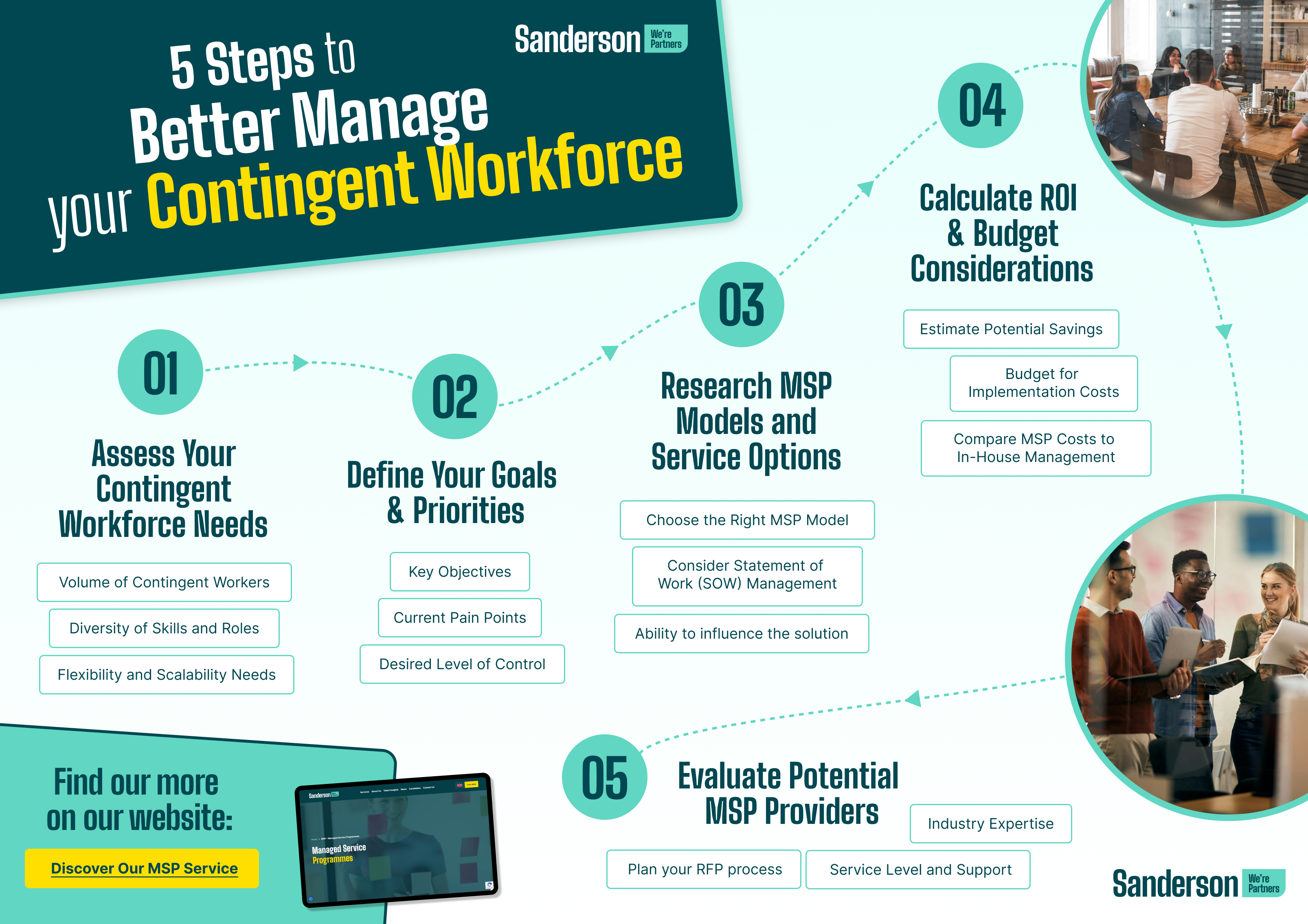
Unlocking Success: 5 steps to better manage your contingent workforce

Posted May 15, 2025

If you’ve arrived on this blog, then it’s likely your business operations involve managing a contingent workforce.

And that means you’re aware of how many moving parts this entails and that you probably have a never-ending list of administrative tasks piling up on your desk.

If you saw our recent blog on how an MSP (Managed Service Programme) can take the pain points away when you’re managing your contingent workers, then you’re undoubtedly ready and waiting to get started with an MSP of your own.

But where do you start?

In this blog we’ll walk you through a simple five step process of everything you need to consider to start the journey of making managing your contingent workforce a breeze. (And if you get to the end and find you might actually need a bit of help auditing your contingent workforce – just get in touch).

Let’s go!

Step 1: Audit Your Contingent Workforce Needs

Volume of Contingent Workers

First things first, it’s important to begin by getting a clear picture of what your contingent workforce population currently looks like. Understanding not only how many contingent workers you have, but also what their worker status is, how much you’re spending on contingent workers, and their tenure will help to identify your current requirements.

You can use this information to map out how this might change in the future based on your business needs and ensure that you’re picking an MSP partner with the financial stability to manage your contingent worker spend.

Diversity of Skills and Roles

During your initial audit, you should also consider the range of skills and the types of roles you’re hiring for.

Do you need a variety of different skills or are you focusing in on once niche skill set? Do you need these roles to be based across multiple locations or are they all centralised?

Mapping out these requirements and handing them over to an MSP partner will help to streamline the process and avoid you having to keep multiple plates spinning.

Flexibility and Scalability Needs

During this step you should also have a think about your future business plans. Do you anticipate any fluctuations in demand? Maybe you’re looking to expand one of your business lines and you need people on the ground to make it happen?

By utilising an MSP you’ll be supported in strategic workforce planning and be far better set up to rapidly scale your business by getting feet on the ground, where you need them.


Step 2: Define Your Goals & Priorities

Key Objectives

So now you know where you’re currently at with your contingent workforce, it’s time to take a look at where you want to go and lay out on paper exactly what you want to achieve with an MSP.

This might be cost savings, ensuring compliance with necessary regulations, getting better access to quality talent or maybe even reducing the administrative burden on you and your teams.

Current Pain Points

During this step you should also assess what challenges you’re currently facing while managing your contingent workforce.

Maybe there’s a lack of visibility across the business on what’s going on with the contingent worker population, maybe you’ve got concerns about IR35 or maybe it’s just that you’re finding it difficult managing multiple talent suppliers and the quality of people you’re currently getting isn’t quite what you’re after.

Desired Level of Control

You should also try and decide exactly how much direct control you want over your contingent workers versus how much you’re comfortable completely outsourcing.

MSPs can vary in how they manage vendor relationships so make sure you know exactly what you’re after at the outset. Would an automated and ‘technology first’ approach work for you and your business, or do you think your hiring managers would prefer an MSP partner who can be onsite when deploying new workers to offer more hands-on support?


Step 3: Research MSP Models & Service Options

Choose the Right MSP Model

Next up its time to do your research and scope out what sort of MSP might be the best fit for you. Consider the needs that you defined in Step 2, and with these in mind determine which MSP model might be the best fit. (You can remind yourself on the differences between a master, neutral or hybrid MSP model in this blog).

Consider Statement of Work (SOW) Management

Do you use SOW contracts for your project-based work? If you do it’s worth making note of this during your research phase as you might benefit from an MSP that integrates both contingent labour and SOW management.

With an MSP this could be a day one service or even part of a continuous improvement programme, so make sure you know if it’s relevant to your work.

Ability to Influence the Solution

Now you’ve nailed Step 2 and decided what level of control you require, take the research phase as an opportunity to assess what level of influence you need over your MSP provider. If you want this to be a little more customisable, keep a look out for MSP partners who can tailor their solutions to your specific industry, workforce needs and the location you want the talent to be based.


Step 4: Calculate ROI and Budget Considerations

Estimate Potential Savings

If you’re looking to get started with an MSP of your own, then you’re probably already aware of the potential cost savings that this can bring you and your business. With benefits such as competitive supplier negotiations, rate card management, direct sourcing discounts and even just more streamlined processes, MSPs can deliver you a huge range of possible savings.

During this step, have a go at evaluating the potential financial impact you could get from an MSP to make sure you’re getting the most bang for your buck as you get started.

Budget for Implementation Costs

You should also take the time to consider any upfront costs your business will have to make when initially implementing your MSP. This might be anything from new technology that will need to be integrated, supplier transition costs or even factoring in the cost of training.

Compare MSP Costs to In-House Management

Finally, it would be worth factoring in the costs of managing your contingent workers in-house versus the fees associated with an MSP. Having this laid out will help you demonstrate the cost saving benefits to the stakeholders in your business.


Step 5: Evaluate Potential MSP Providers

Industry Expertise

And now we get to the fifth and final step in getting started with an MSP. When you’re looking to get started with rolling out an MSP it’s important that you do your research on potential providers. It’s recommended to look for MSPs with experience in your industry (or similar industry) as this will ensure they have specialist knowledge and can tap into relevant networks for you.

We’d recommend looking for suppliers who are happy to introduce you to current clients and invite you to meet their teams so you can take any references you need and meet the people who will be delivering your service.

Service Level Support

When comparing potential MSP providers, one of the aspects you should evaluate is the level of support you’ll be offered, particularly during implementation and for ongoing account management.

Do you have the option of on-site support if you need it? What sort of resources are available to you for troubleshooting? These are important things to get answers to out the outset to avoid any last-minute panic down the line.

Plan Your RFP Process

Last but my no means least, make sure you set yourself up for success in the RFP (Request For Proposal) process by planning out what questions you need to ask.

During this stage, you need to be able to adequately ascertain whether the MSP providers you’re considering have not only the size, financial stability and experience to meet your needs, but also that they align with your company values and that you can feel confident they’ll represent and communicate your employer brand effectively.

Top Tip – Why not ask the providers you’re considering if they’ll share their RFP templates with you so you can get more of an idea of the key questions you need to be asking?


Ready to get started?

A Managed Service Programme (MSP) can help you to ditch the admin and deliver real business value from your contingent workforce.

Now you know what steps you need to take to get started, why not get stuck into figuring out which MSP model is right for you? We’re on hand to help guide you on which MSP model might work for you and your business, as well as what each of their benefits are.

Our mission is to deliver a best-in-class MSP service, and we use our unique combination of brilliant people, effective processes, innovative technologies and seamless collaboration to deliver this. As part of this mission, we’ve put together our Ultimate Guide to MSPs to set you up for success – and all you need to do is fill in the short form below.

Have any more questions? Please do reach out to Elizabeth Hawkins for a chat about how you can get started with managing your contingent workforce today on [email protected]

Want to find out more? Check out our Ultimate Guide to MSPs!

Blue Banner Image for Content

How to take the pain points away when managing your contingent workforce

Posted April 8, 2025

If your business operations involve managing a contingent workforce, you’ll be aware of how many moving parts this entails.

Whether it’s managing contractors and temporary employees, or consultants deployed under Statement of Work (SoW) agreements, there’s a lot to consider and it can create a lot of pain points for busy hiring managers.

You might find yourself buried in administrative tasks, dealing with clunky hiring processes that need a refresh, budget concerns if you’re not sure where all the costs are coming from, or even up come up against a brick wall when you need to bring in the right people to achieve your goals but don’t know where to turn.

This is where a Managed Service Programme (or MSP) comes in.

In this blog we’ll get stuck into the three most common pain points that might arise when managing your contingent workforce and how working with an MSP partner can help to take them away.

Let’s get started…

Attraction, Selection and Screening Candidates

So, you’re looking to hire contingent workers for a new project, but which route should you take (contractor / temp / consultant) and how do you find the time to attract and select the best talent when you have so many other demands on your time? With an MSP in place, your MSP partner will take the reins so you can sit back and focus on the day to day of running your business.

They will optimise processes to make it easy to gain approval for new hires and have access to the latest market intelligence to help your resource planning and budgeting. The MSP partner can either source directly or tap into a wide range of suppliers to create a pre-screened talent pool for you and take away the admin for scheduling interviews and managing offers, which saves you time and helps you engage with the best talent in the most cost-effective manner. An MSP also means consistent points of contact for both hiring managers, candidates and suppliers, ensuring consistent engagement whilst enabling you to concentrate on other priorities – a win win!

A common piece of feedback I receive from Programme Leaders is that they often opt for more expensive consultancy resource because the approval and selection process is so much easier. MSP solutions optimise processes to enable hiring managers to realise cost savings by hiring contractors and reduce the time to deploy and admin overheads’, Tom Moss, Head of Client Solutions.

Onboarding Contingent Employees

Once the interviews are completed and your candidates are selected, it’s time to onboard your people and, the need to ensure robust compliance can create a lot of bottle necks.

You ultimately want to mitigate risk in as smooth a process as possible and an MSP can provide that for both you as an employer, and your candidates. Your MSP partner will support your hiring managers with compliance documentation and process standardisation which will reduce your back and forth with suppliers – and they can even be on site to assist on the day.

And say goodbye to arranging laptops and IT set ups in time for a candidates start date, the MSP does all of this for you so you can get back to business.

You took personal attention in lots of aspects of onboarding to help achieve great outcomes without compromising any of the important rigour, and the result is that our resource is in the building in time for a critical start date. I’m massively thankful for your help.” Feedback from hiring manager at Insurance client.

Offboarding your Contingent Workforce

Now the project is complete, and your temporary contracts are coming to an end, it’s time for offboarding. A time-consuming process with lots of boxes to tick and admin to complete, this can become a dreaded task for overworked hiring managers, particularly if the decision whether to extend or offboard comes at the last minute.

An MSP can take all this stress away for you. Your MSP partner will manage the full contract process, whether that’s an extension or a termination. The enhanced visibility and reporting provided by an MSP means this process can start 6-8 weeks before the end date, with regular check-ins to support your decision making. They’ll even sort the nitty gritty like the returning of tech and the closing down of IT accounts.

Looking to take your own contingent hiring pain points away?

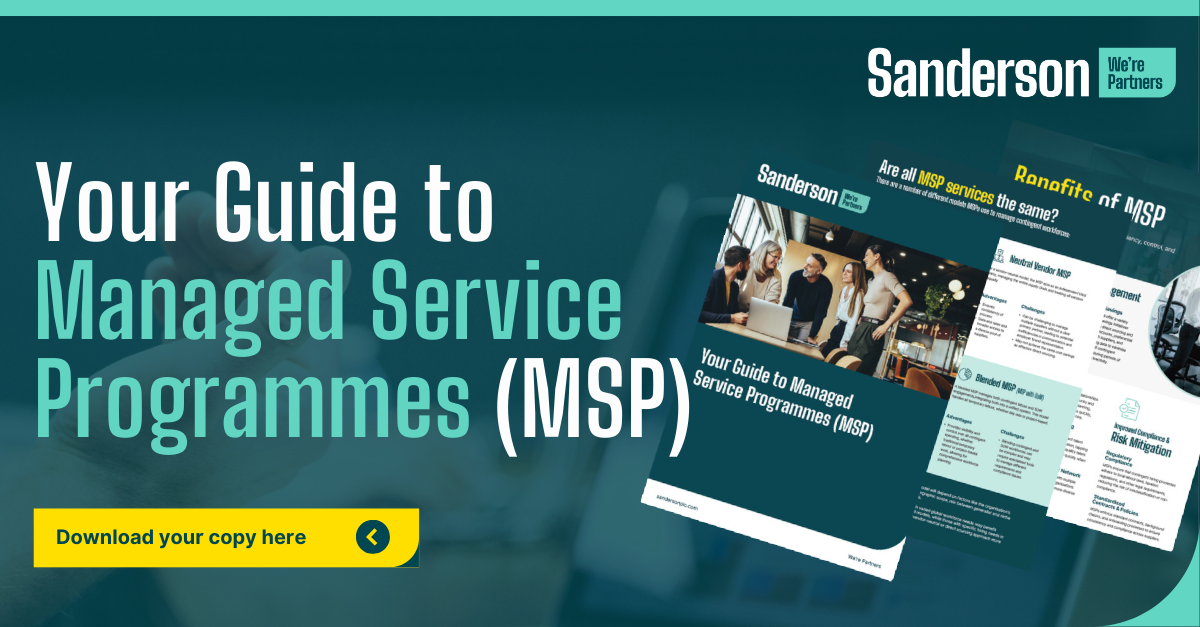
If you’re looking to deliver real business value from your contingent workforce and are ready to ditch the admin and hit the ground running, getting started with an MSP could be the way to go. Why not download our Ultimate Guide on how you can get started today?

Answering all your questions from what types of MSP are available to you, a full brief of the benefits through to how exactly you can get started, this Guide will set you up for success – and all you need to do is fill in the short form below.

Have any more questions? Please do reach out to Tom Moss for a chat about how you can take away the pain points when managing your contingent workforce today on [email protected]

Download our Ultimate Guide to MSPs here

Blue Banner Image for Content

Which Managed Service Programme (MSP) is right for me?

Posted April 2, 2025

If you’re in the market for a more standardised, compliant and cost-efficient approach to the sourcing, onboarding and managing of your contractor population, you might be thinking of engaging with a partner for an MSP (Managed Service Programme).

However, one size does not fit all and there are different approaches and models to consider, all of which we discussed in our recent Guide. Whilst all MSPs bring a dedicated account team to drive efficient processes across the different stages of managing contingent workforces, from attraction, selection, onboarding, pre-engagement screening, and then offboarding, the major difference is the approach to candidate sourcing.

In this blog, we run through the different models and how they might benefit your organisation so that you can decide which one is right for you.

Let’s get stuck in…

Master Vendor MSP

Master Vendor is an MSP solution in which one MSP partner takes responsibility for the management of the end-to-end process and the sourcing of candidates themselves. They build a second-tier supply chain but only utilise it if they require additional help.

A Master Vendor MSP partner acts as the primary resourcing provider for your organisation. The partner will take direct responsibility for candidate sourcing, pre-screening and management, as well as building talent pipelines for future vacancies. They will only engage with other agencies if they cannot fulfil the role and need a bit of extra help. Basically, they’ll completely take the resourcing challenges and time-consuming admin tasks off your hands.

Advantages

This model offers a more streamlined process as one partner takes responsibility for all activity. Not only does this bring more accountability for hiring difficult to fill roles but will often result in quicker placements and a creation of talent pipelines for future roles, driving down your future time to hire.

Master Vendor MSP enables you to leverage economies of scale to realise significant cost savings through a simple pricing structure. A Master Vendor MSP also creates consistency of experience. The candidate experience will be more consistent as they are only dealing with one point of contact, and it will also help to improve the amplification of your employer brand messaging.

Challenges

When looking to engage with a master vendor MSP provider, selecting the right partner is key.

If you operate in a particularly niche market or are needing to flesh out your team for a very technical project, then be aware that some suppliers might not have the direct sourcing capability to provide access to the niche talent or specialised skills you require. It pays to do your research. A specialist master vend partner will be able to demonstrate the ability to source at least 90% of all roles directly.

This is particularly relevant if you’re needing to recruit over multiple locations, or even regions, it should also be noted that with a master vendor approach, it may be difficult to deploy workers consistently across a multi-region solution.

Neutral Vendor MSP

Next up, you’ve got your neutral vendor MSP model. When you’re working with an MSP partner in a neutral vendor capacity, this mean they will be acting as an intermediary between your company and the roles you need filling, and multiple other recruitment agencies. Think of them as being able to play the field for you.

They’ll review candidates from all these different sources and present the best options to you, regardless of source.

Advantages

The neutral vendor approach will spread out your risk and diversify your talent supply chains, which can then provide you with wider and more diverse access to talent.

You could also maximise some cost savings thanks to the transparency of this approach and being able to review the pricing structures of multiple different suppliers. A diverse supply chain builds scalability and flexibility into a solution.

Challenges

However, a neutral vendor approach may not achieve the same cost savings as a direct sourcing model as there will be two organisations to pay for each hire made, the agency supplier as well as the MSP partner.

Also, you should pay special attention to how each agency is presenting your employer brand to avoid a misalignment in how you’re being represented.

Hybrid Model MSP

Then you’ve got your hybrid model MSP partner. This combines some elements of both the vendor-neutral and the master vendor approaches.

With a hybrid model, the MSP partner may deliver to you via direct sourcing, while also appointing other primary suppliers and opening some of your roles up to a wider pool in the supply chain.

Advantages

A huge advantage you get with the hybrid model is flexibility as you’ll be able to choose the best model per job category. This could mean that your technology hiring is conducted via a neutral vendor approach, while your HR function is handled through a master vendor. This will optimise costs and efficiency while maintaining access to diverse suppliers.

This approach also means you’re not going to be limited by jurisdictions. You can easily hire across various geographical locations and get the best talent on the ground thanks to the expertise of different suppliers based where you need them – say goodbye to compromising on worker quality.

Challenges

However, a hybrid model approach does come with its own set of potential challenges. When you’re working with different MSP models operating for different job categories it can become a hugely complex process to manage. The hybrid model can work very effectively for large, multi-region contracts, mitigating risk and ensuring compliance with local regulations. For mid-size solutions (100 – 750 contractors under management) it may prove overly complex and not deliver the same benefits as the other models.

Which model is right for you?

So, which model do you think is right for you?

Well, it depends. The most appropriate model will depend on factors like your organisation’s size, industry sector, geographic scope, the mix between generalist and niche skills that you’re hiring for, not to mention your strategic goals.

Looking for more information?

We’re on hand to help guide you on which MSP model might be right for you and your business, and how you can get started.

You can find out more in our comprehensive Guide to MSP. Answering all of your questions from what the benefits are through to how to get started, this Guide will set you up for success.

If you have any further questions or would like to chat to us more, please don’t hesitate to reach out to:

Chesney Windsor – [email protected]

Or

Lisa Goodman – [email protected]


Download our Ultimate Guide to MSP here