
Blue Banner Image for Content

Navigating the Financial Services Job Market: Most Hired Roles & Future Insights

Posted April 10, 2025

In case you missed it, we recently launched our Financial Services Hiring Trends Report which focuses on Digital, Technology, Change and Transformation hiring in the Financial Services sector. The Report delves into how hiring in 2024 compared to the previous year, how hiring demand was split across the UK and what the job market looked like across the financial services sector.

But what exactly were the most in demand and most hired roles in this sector, and what does this tell us about trends we can predict for the rest of the year?

Most Hired Roles

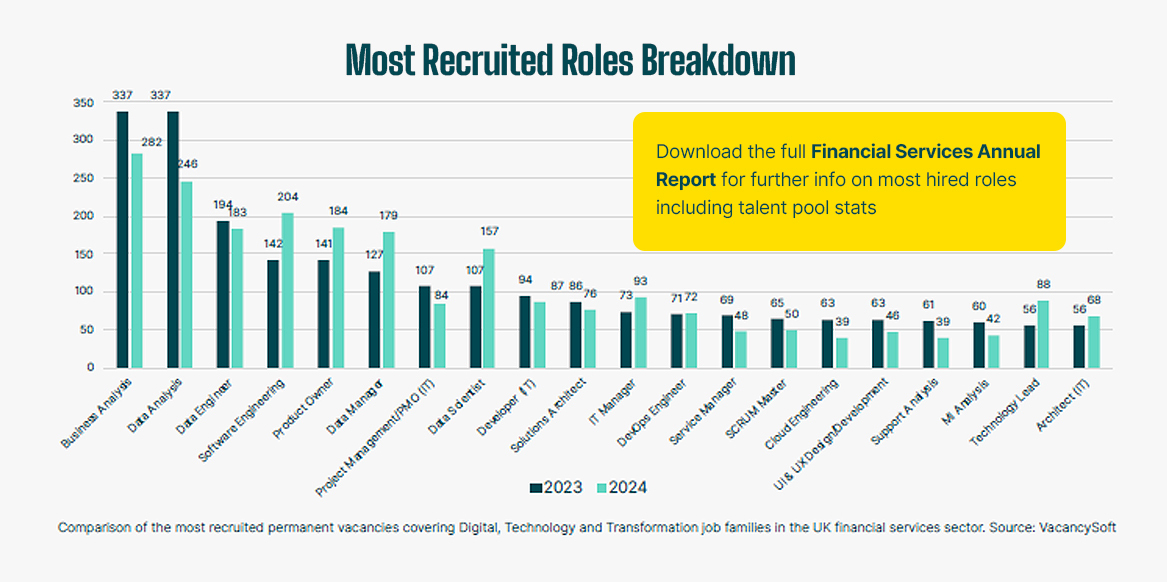
Software Engineer and Developer

Our data showed us that Software Engineer and Developer roles soared above Business Analysts as the most in demand roles for 2024. This is likely thanks to the significant investment We have seen this trend in action already during Q1 of 2025 by placing 42% more Developer roles than we have Business Analysts.

Business Analyst

The demand for Business Analysts has traditionally always been high in the financial sector thanks to companies looking to optimise their processes, improve efficiencies and integrate the latest technologies, and this was yet again the case in 2024.

Data Analyst

The role of Data Analysts remained essential as many financial services organisations searched for candidates who can turn huge amounts of data into actionable insights. As, data underpins the business strategies of many financial organisations moving forwards, this continued surge in demand is expected.

Data Engineer

As data-driven decision-making continued to take hold of businesses, there was a continued necessity for clean and well-structured data, especially among those companies in the financial services sector who are hoping to leverage AI tools. We therefore saw a huge growth in the demand for Data Engineers both on a permanent and interim basis in addition to a desire to grow their own data talent through innovative capability development models.
Hiring Predictions for 2025

In terms of hiring demand, I believe we can head into the rest of 2025 with a cautious optimism. Throughout the first few months of the year, we saw resourcing requirements for permanent hiring improve by 6% during Q1 of 2025 compared to Q4 2024 and contingent talent demand improve by 2%. Already a lot of our clients are expressing an interest in hiring in greater numbers this year, and a particular theme we are seeing is hiring for Artificial Intelligence skill sets. Many of our clients have indicated they are considering how this will impact their ways of working and how they can transform to successfully leverage any benefits AI may offer in a compliant and ethical manner.

I believe there will continue to be a strong demand for talent in the financial services space, particularly for data roles.

However, I do predict that employer preferences will start to shift away from a skill sets focus, and more towards the capability of candidates.

The word ‘Curiosity’ is coming up more and more frequently in discussions with Financial Services technology clients in relation to the type of person they would like to hire; be that permanent or non-permanent.  In a world where technological advancements are fast evolving, our clients want to hire adaptable talent with a hunger to learn and to have a keen interest in ‘Why’ and ‘What Value’ the products they are building will deliver to the end user; be that the end customer or colleagues.

Increasingly during our briefings for individuals and teams, our clients are looking for a baseline technical skillset but the adaptability of the candidate to grow.  This means that we not only need to select candidates for their skillset and background, but also for behavioural characteristics like aptitude and agility.

We are already advancing in this direction through our Sanderson Projects service and also our exclusive permanent campaigns whereby cognitive behavioural testing and behavioural interviewing are embedded into the selection process.

This approach will provide clients with an approach that promotes cultural fit and alignment to company values, and retention and satisfaction within their workforce into the future.

In addition to hiring for capability at the experienced end of the market, we are also seeing a ‘grow your own’ approach to talent for the future.  This is due to the rise in organisations identifying their future talent shortages and focusing on how they can prepare for this via capability development programmes in order to hire more junior, diverse and talented individuals, develop them in role and ensure they have the skills their teams need both now and into the future.

Next steps

Are you ready to find out more?

As we start Q2 and look to the summer, now is the time to start thinking about enhancing operational efficiencies, addressing your skills gaps and supporting the reskilling of your existing workforce with the right blend of permanent employees, contractors and consultancies.

Arm yourself with data including exact talent pool numbers, tenue statistics, gender breakdowns and regional hot spots for the roles discussed above by downloading a copy of our Financial Services Hiring Trends Annual Report via the short form below.

Have any further questions or considering how your business can get ahead of these predictions? Please don’t hesitate to get in touch with me on [email protected]
Download the Financial Services Hiring Trends Annual Report here

Blue Banner Image for Content

Cultivating Harmony White Paper: Strategies for a Multi-Generational Workforce

Posted April 9, 2025

Sanderson Government & Defence is pleased to present this new White Paper produced in partnership with The HR World. The Paper provides a vital insight into the importance and potential of the multi-generational workforce and brings together the ideas and experiences of some of the leading HR practitioners in the UK.

The multi-generational workforce represents one of the most challenging aspects about the workplace today. With some organisations seeing up to five generations working side by side, it’s an issue which impacts on all areas of HR and the running of an age diverse team is an aspect of the workplace that requires a lot of careful consideration.

Challenges of a Multi-Generational Workforce

A multi-generational workforce can cause challenges such as:

  • Communication gaps and different generations preferring different methods of communicating.
  • Different generations having different expectations from the workplace both in terms of what they put in and what they get out.
  • Knowledge transferring and succession planning as older generations retire.

Opportunities of a Multi-Generational Workforce

However, with these challenges also come opportunities.

An age diverse workforce means a business can make the most of the talent that’s out there. It can bring in diverse viewpoints, strengths and ideas for the good of all parts of the organisation. It can not only use the skills of everyone in the organisation, but it can also confidently appeal to every generation in its customer base.

Strategies for working with a Multi-Generational Workforce

Offering a comprehensive insight into how the multigenerational workforce operates in today’s workplace, this White Paper provides you with practical steps for organisations to follow in order to get more from all their employees including:

  • Fostering Open Communication
  • Embracing Flexibility
  • Implementing Mentoring and Reverse Mentoring
  • Creating Inclusive Policies
  • Encouraging Continuous Learning

As the workforce and talent pool continues to diversify, HR needs to develop the right approach to welcome and maximise the benefit of its age diverse employees. With Generation Alpha waiting in the wings, the challenge of delivering for everyone in the workplace will only increase.

Make sure you’re prepared by finding out more in the full White Paper. Download your own copy by filling out the short form below and don’t hesitate to get in touch with Nick Walrond or Mollie Hatton if you have any further questions or would like to chat about this topic further.

Are you ready to maximise the benefits of your age diverse workforce? Find strategies for multi-generational success in this new White Paper.

Blue Banner Image for Content

How to take the pain points away when managing your contingent workforce

Posted April 8, 2025

If your business operations involve managing a contingent workforce, you’ll be aware of how many moving parts this entails.

Whether it’s managing contractors and temporary employees, or consultants deployed under Statement of Work (SoW) agreements, there’s a lot to consider and it can create a lot of pain points for busy hiring managers.

You might find yourself buried in administrative tasks, dealing with clunky hiring processes that need a refresh, budget concerns if you’re not sure where all the costs are coming from, or even up come up against a brick wall when you need to bring in the right people to achieve your goals but don’t know where to turn.

This is where a Managed Service Programme (or MSP) comes in.

In this blog we’ll get stuck into the three most common pain points that might arise when managing your contingent workforce and how working with an MSP partner can help to take them away.

Let’s get started…

Attraction, Selection and Screening Candidates

So, you’re looking to hire contingent workers for a new project, but which route should you take (contractor / temp / consultant) and how do you find the time to attract and select the best talent when you have so many other demands on your time? With an MSP in place, your MSP partner will take the reins so you can sit back and focus on the day to day of running your business.

They will optimise processes to make it easy to gain approval for new hires and have access to the latest market intelligence to help your resource planning and budgeting. The MSP partner can either source directly or tap into a wide range of suppliers to create a pre-screened talent pool for you and take away the admin for scheduling interviews and managing offers, which saves you time and helps you engage with the best talent in the most cost-effective manner. An MSP also means consistent points of contact for both hiring managers, candidates and suppliers, ensuring consistent engagement whilst enabling you to concentrate on other priorities – a win win!

A common piece of feedback I receive from Programme Leaders is that they often opt for more expensive consultancy resource because the approval and selection process is so much easier. MSP solutions optimise processes to enable hiring managers to realise cost savings by hiring contractors and reduce the time to deploy and admin overheads’, Tom Moss, Head of Client Solutions.

Onboarding Contingent Employees

Once the interviews are completed and your candidates are selected, it’s time to onboard your people and, the need to ensure robust compliance can create a lot of bottle necks.

You ultimately want to mitigate risk in as smooth a process as possible and an MSP can provide that for both you as an employer, and your candidates. Your MSP partner will support your hiring managers with compliance documentation and process standardisation which will reduce your back and forth with suppliers – and they can even be on site to assist on the day.

And say goodbye to arranging laptops and IT set ups in time for a candidates start date, the MSP does all of this for you so you can get back to business.

You took personal attention in lots of aspects of onboarding to help achieve great outcomes without compromising any of the important rigour, and the result is that our resource is in the building in time for a critical start date. I’m massively thankful for your help.” Feedback from hiring manager at Insurance client.

Offboarding your Contingent Workforce

Now the project is complete, and your temporary contracts are coming to an end, it’s time for offboarding. A time-consuming process with lots of boxes to tick and admin to complete, this can become a dreaded task for overworked hiring managers, particularly if the decision whether to extend or offboard comes at the last minute.

An MSP can take all this stress away for you. Your MSP partner will manage the full contract process, whether that’s an extension or a termination. The enhanced visibility and reporting provided by an MSP means this process can start 6-8 weeks before the end date, with regular check-ins to support your decision making. They’ll even sort the nitty gritty like the returning of tech and the closing down of IT accounts.

Looking to take your own contingent hiring pain points away?

If you’re looking to deliver real business value from your contingent workforce and are ready to ditch the admin and hit the ground running, getting started with an MSP could be the way to go. Why not download our Ultimate Guide on how you can get started today?

Answering all your questions from what types of MSP are available to you, a full brief of the benefits through to how exactly you can get started, this Guide will set you up for success – and all you need to do is fill in the short form below.

Have any more questions? Please do reach out to Tom Moss for a chat about how you can take away the pain points when managing your contingent workforce today on [email protected]

Download our Ultimate Guide to MSPs here

Blue Banner Image for Content

Technology & Digital Insights Report Q1 2025

Posted April 3, 2025

We’re pleased to present Sanderson’s brand-new Technology & Digital Insights Report for Q1 2025.

With signs of growth on the horizon we get stuck into latest trends so you can get ahead of the curve and win the best talent in what’s shaping up to be a competitive market place.

Have you noticed the shift in businesses looking to invest in specialist skill sets?

According to our data the demand for Data Engineering roles specialising in Cloud Technologies like Azure is surging as many companies integrate big data, AI and machine learning into their operations.

But if you want to keep up with data security requirements, enable scalability and stay on top of emerging methodologies, you’ll need people who can work across multiple platforms with a focus on:

⚠️Python
⚠️JavaScript
⚠️Node
⚠️Typescript Languages

With these trends set to continue through 2025, you’ll want to download the full report via the link below to ensure your Tech, Data and Cyber salaries are stacking up against others in your region and set your business up for success.

Download your copy of the Tech & Digital Q1 2025 Insights Report here

Blue Banner Image for Content

Which Managed Service Programme (MSP) is right for me?

Posted April 2, 2025

If you’re in the market for a more standardised, compliant and cost-efficient approach to the sourcing, onboarding and managing of your contractor population, you might be thinking of engaging with a partner for an MSP (Managed Service Programme).

However, one size does not fit all and there are different approaches and models to consider, all of which we discussed in our recent Guide. Whilst all MSPs bring a dedicated account team to drive efficient processes across the different stages of managing contingent workforces, from attraction, selection, onboarding, pre-engagement screening, and then offboarding, the major difference is the approach to candidate sourcing.

In this blog, we run through the different models and how they might benefit your organisation so that you can decide which one is right for you.

Let’s get stuck in…

Master Vendor MSP

Master Vendor is an MSP solution in which one MSP partner takes responsibility for the management of the end-to-end process and the sourcing of candidates themselves. They build a second-tier supply chain but only utilise it if they require additional help.

A Master Vendor MSP partner acts as the primary resourcing provider for your organisation. The partner will take direct responsibility for candidate sourcing, pre-screening and management, as well as building talent pipelines for future vacancies. They will only engage with other agencies if they cannot fulfil the role and need a bit of extra help. Basically, they’ll completely take the resourcing challenges and time-consuming admin tasks off your hands.

Advantages

This model offers a more streamlined process as one partner takes responsibility for all activity. Not only does this bring more accountability for hiring difficult to fill roles but will often result in quicker placements and a creation of talent pipelines for future roles, driving down your future time to hire.

Master Vendor MSP enables you to leverage economies of scale to realise significant cost savings through a simple pricing structure. A Master Vendor MSP also creates consistency of experience. The candidate experience will be more consistent as they are only dealing with one point of contact, and it will also help to improve the amplification of your employer brand messaging.

Challenges

When looking to engage with a master vendor MSP provider, selecting the right partner is key.

If you operate in a particularly niche market or are needing to flesh out your team for a very technical project, then be aware that some suppliers might not have the direct sourcing capability to provide access to the niche talent or specialised skills you require. It pays to do your research. A specialist master vend partner will be able to demonstrate the ability to source at least 90% of all roles directly.

This is particularly relevant if you’re needing to recruit over multiple locations, or even regions, it should also be noted that with a master vendor approach, it may be difficult to deploy workers consistently across a multi-region solution.

Neutral Vendor MSP

Next up, you’ve got your neutral vendor MSP model. When you’re working with an MSP partner in a neutral vendor capacity, this mean they will be acting as an intermediary between your company and the roles you need filling, and multiple other recruitment agencies. Think of them as being able to play the field for you.

They’ll review candidates from all these different sources and present the best options to you, regardless of source.

Advantages

The neutral vendor approach will spread out your risk and diversify your talent supply chains, which can then provide you with wider and more diverse access to talent.

You could also maximise some cost savings thanks to the transparency of this approach and being able to review the pricing structures of multiple different suppliers. A diverse supply chain builds scalability and flexibility into a solution.

Challenges

However, a neutral vendor approach may not achieve the same cost savings as a direct sourcing model as there will be two organisations to pay for each hire made, the agency supplier as well as the MSP partner.

Also, you should pay special attention to how each agency is presenting your employer brand to avoid a misalignment in how you’re being represented.

Hybrid Model MSP

Then you’ve got your hybrid model MSP partner. This combines some elements of both the vendor-neutral and the master vendor approaches.

With a hybrid model, the MSP partner may deliver to you via direct sourcing, while also appointing other primary suppliers and opening some of your roles up to a wider pool in the supply chain.

Advantages

A huge advantage you get with the hybrid model is flexibility as you’ll be able to choose the best model per job category. This could mean that your technology hiring is conducted via a neutral vendor approach, while your HR function is handled through a master vendor. This will optimise costs and efficiency while maintaining access to diverse suppliers.

This approach also means you’re not going to be limited by jurisdictions. You can easily hire across various geographical locations and get the best talent on the ground thanks to the expertise of different suppliers based where you need them – say goodbye to compromising on worker quality.

Challenges

However, a hybrid model approach does come with its own set of potential challenges. When you’re working with different MSP models operating for different job categories it can become a hugely complex process to manage. The hybrid model can work very effectively for large, multi-region contracts, mitigating risk and ensuring compliance with local regulations. For mid-size solutions (100 – 750 contractors under management) it may prove overly complex and not deliver the same benefits as the other models.

Which model is right for you?

So, which model do you think is right for you?

Well, it depends. The most appropriate model will depend on factors like your organisation’s size, industry sector, geographic scope, the mix between generalist and niche skills that you’re hiring for, not to mention your strategic goals.

Looking for more information?

We’re on hand to help guide you on which MSP model might be right for you and your business, and how you can get started.

You can find out more in our comprehensive Guide to MSP. Answering all of your questions from what the benefits are through to how to get started, this Guide will set you up for success.

If you have any further questions or would like to chat to us more, please don’t hesitate to reach out to:

Chesney Windsor – [email protected]

Or

Lisa Goodman – [email protected]


Download our Ultimate Guide to MSP here

Blue Banner Image for Content

What’s new in Government & Defence recruitment: Our thoughts on the market

Posted March 24, 2025

We’re now well into 2025 and it’s been a busy start to the year for Sanderson Government & Defence. But what can we learn from the last few months, and what can we expect from the rest of 2025 in the world of recruitment?

We sat down with G&D’s Head of Recruitment Services James Corcoran for his opinion on how the government and defence market has been looking and where it might be heading.

Focusing on permanent hiring

Well things are changing. It’s been a topsy turvy market over the course of the last 18 months where I’ve seen many organisations swing from putting all their focus on contract hiring, then onto permanent hiring and then back again in a recurring cycle.

But as we started this year, I’ve noticed more stability. Since beginning 2025 with a heavy focus on contract hiring, there’s been a huge shift in interest and conversations leaning more towards permanent hiring. The G&D team have been flying from meeting to meeting lately handing queries from customers on how to design, implement and then deliver numerous projects needing permanent hires.

To be honest, this was a trend I was expecting due to the increase in employer National Insurance contributions the government is implementing, and also the similarities in the market trends to the post financial crisis market. Companies are wanting more value for money with better return on investment, so I’m pleased to see the growth of businesses becoming more attune to the cost of hiring and the value of permanent staff – we’re moving away from the trend of just “hire and hope”.

Filling the skills gaps

Then there’s the change in attitude to the skills gaps that have been present in the government and defence job market.

While some of these gaps will remain due to reactive hiring spurred on by programme wins across the industry, a lot of these gaps will also be plugged. I expect to see a burst of strategic hires taking place in more challenging positions to fill any future skills gaps, as well as training programmes to further plug these gaps.

I strongly believe that its vital companies continue to focus on overcoming their skills gaps to ensure they’re preparing for the future. In my experience it’s key to show stakeholders the return on investment this will bring in order to get everyone on board with hiring pushes or training programmes. We would advise ring fencing a project that has defined outcomes that all stakeholders have agreed on, to increase engagement, foster commitment and prove value for money.

How can we help?

At Sanderson Government & Defence we have a wealth of experience in bringing stakeholders on this journey to ensure your training programme or recruitment drive gets off the ground.

We specialise in starting these conversations, setting up reskilling programmes and sourcing hard to find and hard to reach skill sets that will support your programme of work. The key is to deliver a tailored, outcome orientated service to ensure best value for money and best return on investment – the exact type of work that gets us up in the morning!

If this sounds like something your organisation needs, or you’d just like to chat about how you can start addressing your permanent hiring needs or how to start filling skills gaps, then please do get in touch with me on [email protected]
Blue Banner Image for Content

What’s Happening with Financial Services Recruitment in London?

Posted March 20, 2025

We recently launched our much-anticipated Financial Services Hiring Trends Report which focuses on Digital, Technology, Change and Transformation hiring in the Financial Services sector. The Report delves into how hiring in 2024 compared to the previous year, how hiring demand was split across the UK and what the most in demand roles were across the financial services sector.

But what did the data show us about trends in London?

Permanent finance vacancies

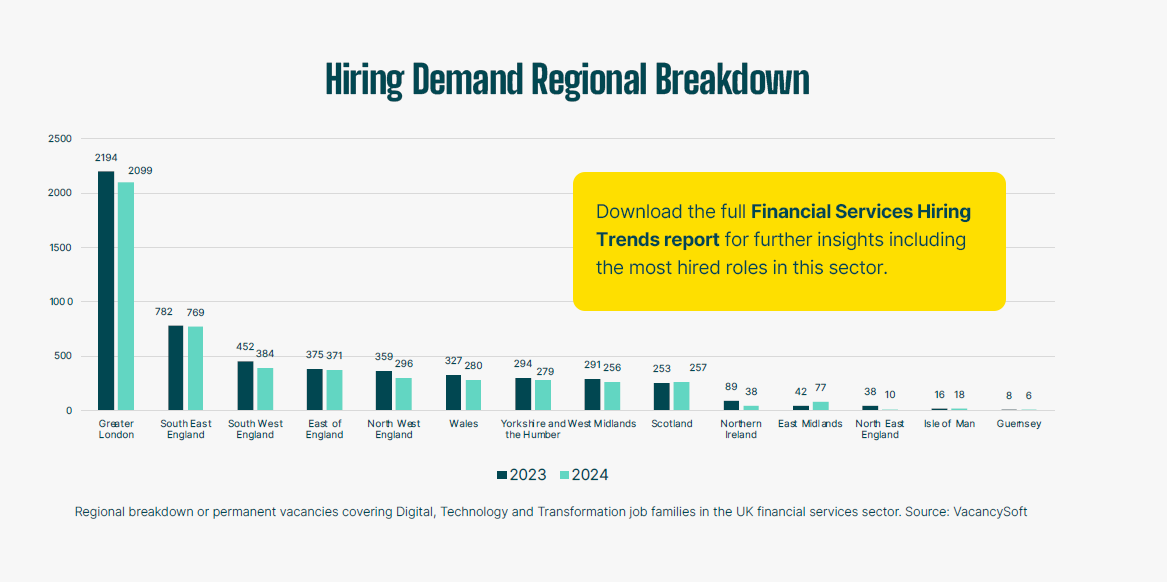
According to data from VacancySoft and reviewed by our expert recruiters, the hiring demand for permanent vacancies covering digital, technology, change and transformation in the UK financial services sector has remained highest across Greater London and the South-East of England.

In 2023 there were 2194 vacancies in Greater London, and then an equally high 2099 in 2024. Looking at the South-East region, there were 782 vacancies in 2023 followed by 769 in 2024.


These vacancies are miles ahead in numbers compared to the rest of the UK. For example, the North-West only saw 359 and 296 vacancies in 2023 and 2024 respectively, and the West Midlands only had 291 and 256. This confirms that London and surrounding areas are a real hub of talent and that there continues to be a real demand for talent in the financial services sector.

Hiring trends in London

London is one of Sanderson’s largest markets in the financial services sector, with our expertise spanning across General Insurance, London Market Insurance, Life & Pensions, Investment Management, Banking and Building Societies.

When you look at the hiring trends in this region across the world of Finance, it’s clear that London continues to lead the way in UK in digital, technology, change and transformation hiring in the financial services sector. Hiring demand in London has also been more resilient to the impact of external factors like political uncertainty and economic challenges. This is demonstrated by vacancies across the UK declining by 8.5%, whereas they only declined by 4.4% in London – a clear indicator that the market in London remained strong. Also, the trend we saw back in 2023 of a shift away from London towards regional hubs such as Manchester has slowed.

What will the future look like?

It’s clear that London is at the centre of hiring demand in the financial services sector. But what else should we be aware of in this region and sector?

One thing we’ll be keeping a close eye on is the return to the office, particularly in Financial Services firms in London. We’re already seeing more consistent patterns of 3 days per week in the office and a some of our clients returning to as many as 4 days in London across all roles regardless of whether they’re in digital, technology or transformation.

This is a marked swing back towards the majority of the week being spent in the office, and while hybrid working is here to stay, it does mean less choice for job seekers requiring more remote roles.

I’d therefore expect that we start to see less movement in this sector based purely on what hybrid working schedules companies are offering and instead see trends returning to a more level playing field with other factors in the job offering holding more weight as we progress through 2025/2026.

Next steps

Are you ready to find out more?

As we leave Q1 behind, now is the time to start thinking about enhancing operational efficiencies, addressing your skills gaps and supporting the reskilling of your existing workforce with the right blend of permanent employees, contractors and consultancies.

Arm yourself with data produced by Sanderson’s market-leading experts by downloading a copy of our Financial Services Hiring Trends Annual Report by filling out the short form below.

Have any further questions or considering how your London based business can get ahead of these hiring trends? Don’t hesitate to get in touch with Joss Collins on [email protected]

Download the full Financial Services Hiring Trends Annual Report here

Blue Banner Image for Content

Future Skills: Opportunities and Challenges for the UK Government

Posted March 18, 2025

In the rapidly evolving digital landscape, the future skills required by the workforce are changing at an unprecedented pace. The World Economic Forum’s 2024 report on “Fastest Growing and Declining Jobs by 2030” highlights the essential skills needed for the future, presenting both significant opportunities and challenges for the UK government and defence sector.

The Opportunity

The future job market is rich with potential for innovation and growth. For the UK government, this means an opportunity to harness new technologies and methodologies to improve public services and national security.

According to the World Economic Forum report, the fastest-growing jobs include roles such as big data specialists, fintech engineers, and AI and machine learning specialists.

By investing in these areas, the government can drive efficiency, reduce costs, and enhance service delivery. Moreover, the emphasis on green transition roles, such as environmental and renewable energy engineers, aligns with the government’s sustainability goals which also contributes to economic growth and job creation.

The Challenge

However, the shift towards these future skills also presents several challenges. One of the primary hurdles is the existing skills gap. Research by PA Consulting and McKinsey indicates that there is a significant gap between the current skill levels and those required for future roles. This gap needs to be addressed through comprehensive training and development programs.

Another challenge is the need for a cultural shift within government institutions. Traditional hierarchical structures may need to be re-evaluated to create more dynamic and flexible career paths. This shift is essential to attract and retain Gen Z talent, who prioritize flexibility, meaningful work, and a supportive work environment.

Conclusion

The future skills landscape presents a unique opportunity for the UK government to lead in digital transformation and innovation. However, it also requires a concerted effort to address the existing skills gap and to create a work environment that aligns with the values and expectations of the future workforce. The UK government must take proactive steps to embrace these changes, and ensure it is well-equipped to meet the challenges of the future and to continue delivering high-quality public services.

Get in touch

Would you like to chat about this topic further? Don’t hesitate to reach out to Nick Walrond or Mollie Hatton to find out more and continue the conversation.

Nick Walrond – Managing Director – [email protected]

Mollie Hatton – Head of Talent Consulting – [email protected]

insights

Annual Report: Financial Services Hiring Trends

Posted March 12, 2025

We’re pleased to present Sanderson’s brand-new hiring trends report focusing on Digital, Technology, Change and Transformation hiring in the Financial Services sector in 2024.

This much anticipated report arms you with industry-leading data on how hiring in 2024 compared to the previous year, how hiring demand was split across the UK and what the most in demand roles were across the financial services sector.

It will have escaped no one’s attention that hiring trends in 2024 reflected a year of uncertainty. Thanks to economic challenges and political instability, the year saw many companies having to adopt a cautious approach to recruitment as business confidence was knocked.

Many companies in the financial services sector will currently be reassessing their hiring strategies in preparation for the changes in National Insurance contributions for employers set to take effect in April 2025, alongside ensuring they’re business strategies are aligned with the rapid digital transformation AI is bringing to the sector.

Now is the time to think about enhancing operational efficiencies, addressing your skills gaps and supporting the reskilling of your existing workforce with the right blend of permanent employees, contractors and consultancies.

This report, produced by Sanderson’s market-leading experts, reflects on how the business context has been impacted in the past and provides our predictions for the future of hiring in the financial services sector.

Download your copy by filling out the short form below and get all the data you need in your back pocket.

Have any further questions on the trends discussed in this report? Don’t hesitate to contact William Boney at [email protected]

Blue Banner Image for Content

What is an MSP (Managed Service Programme) Anyway?

Posted February 17, 2025

An MSP explained

An MSP (Managed Service Programme) is an outsourcing solution in which a partner takes responsibility for managing the contingent workforce for an organisation.

The contingent workforce can be made up of temporary employees, contractors and consultants deployed under Statement of Work (SoW) agreements.

Typically, an MSP partner will manage the full contingent worker lifecycle from resource planning and approvals, through the end-to-end recruitment process, to onboarding, payroll, extension management and offboarding. In addition, an MSP partner provides market intelligence and guidance, access to great talent, consistency of process, compliance, cost management and reporting across the contingent workforce.

Who may benefit from an MSP?

When they first started, the main appeal of an MSP solution was focussed on the time savings and efficiencies associated with the management of the contingent worker process.

Enterprise organisations with large contingent worker populations (250+), would appoint a partner to ensure that roles had been approved, to co-ordinate the recruitment process and to centralise time keeping and invoices into one, consolidated format.

The introduction of VMS technology has automated much of this process, enabling MSP providers to expand the scope of the service across multiple geographic areas, or, to focus their attentions on cost saving, risk mitigation, and access to high quality contingent talent.

With more agile MSP partners entering the market, size and scale is no longer a barrier to entry for organisations.

What should I be asking before starting an MSP?

The key questions any potential MSP buyer should ask themselves before getting started are:

Are contingent workers a consistent part of your resourcing strategy?

Would you like to access the best contingent talent in the most cost-effective manner?

Is it important that your contingent workforce complies with local regulations and legislation?

Do you struggle to gain visibility of contingent workforce spend across your business?

Does recruiting, managing, and onboarding contingent workers take up more time than you would like?

Ready to find out more?

If you’re looking to deliver real business value from your contingent workforce and are ready to get started with an MSP, download our ultimate guide to getting started today.

Answering all of your questions from what types of MSP are available to you, what the benefits are through to how to get started, this Guide will set you up for success.

Have any more questions? Reach out to Steve Phillips today [email protected]